

Feature – Greek Architecture
Greek structures were composed using a system known as post and lintel, by which a horizontal beam is placed on top of two separated vertical beams (picture the balancing act at Stonehenge). Early temples were built with non-durable materials such as wood and thatching, however, under the influence of stone-working Egyptians (remember the Pyramids?), the Greeks switched over to stone.
Stone architecture evolved in three styles, or orders: Doric, Ionic, and Corinthian.
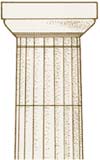
Doric architecture developed directly from mud brick and wood construction, and was the first, and simplest of the three orders. It is easiest to distinguish between the styles by comparing the columns (although orders did go further than just the columns). Doric columns were created by stacking cylindrical blocks (called drums). 20 flutes (or channels/grooves) run up the entire shaft of the column. The column bulges outward in the center. And the block at the top of the column (known as the ‘capital’) is quite plain, consisting only of geometric shapes.
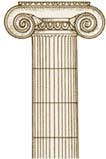
The Ionian order was developed by Greeks who left the mainland and settled in Asia minor. The Ionian order followed the same main geometric principals of Doric architecture, with a few notable differences. Ionic columns were much slimmer than Doric columns, and had many more flutes (40-48; thus the ribs on the columns would be quite narrow in comparison to Doric ribbing). The column capital featured a more ornamental, scroll-shape design.
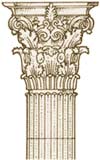
The Corinthian order was very similar to the Ionian, except that the column capitals were much more ornamental, and featured leafy foliage. This order was actually rather rare among the Greeks, and featured more heavily in the later architecture of the Romans.
It is interesting to note that the Greeks were a much more colourful civilization than we imagine looking back. Whereas we see only whitened stone where Greek structures still stand, evidence in Greek writing alludes to bright colours, which would have made the seemingly stolid, calm, and quietly elegant edifices of today look like the pages of a colouring book.Religion was the center of Greek life. It should not, then, be surprising that religion is the focus of Greek architecture, from temples to theatres (please note that theatre, as discussed in the feature article on Greek theatre, was actually a religious act).
Akropolis
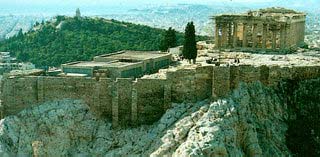
‘Akropolis’ (or Acropolis in modern spelling) was the Greek word for ‘upper city,’ a sort of raised fortification intended to protect the entire city. Akropolis was also the name of one of the most important sites in Athens, and indeed, in all of ancient Greece.
Between 450 and 330 BC, three temples were erected at the Akropolis: the Parthenon (447-438 BC), the Erechtheion(~420 BC), and the Temple of Nike (pronounced Nee-Kay; ~420 BC), as was the Propylaea (437-432 BC), the gateway to the Akropolis.
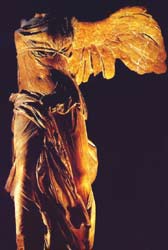
The Temple of Nike was built in adoration of Nike, the goddess of victory. It is built in the Ionic style, and features a series of friezes, which are flat (ish) carvings (surface carvings on a slab, rather than 3-D sculptures that are complete from all angles), depicting memorable scenes between gods or mortals. The Nike friezes depict, appropriately, scenes from battles and conferences between gods (who often determined the outcome of battles, by giving other-worldly support to one of the warring armies).
The Erechtheion was also built in the Ionian style, and was split into two main sections, in adoration of the goddess Athena, goddess of wisdom and patron of Athens, and Poseidon, god of the sea. Outside the temple was a relief wall-painting, probably depicting the birth of Erechtheus, the ancestral figure, and ancient king, of Athens.
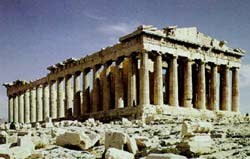
The Parthenon, dedicated to Athena Parthenos, is the most characteristic and important monument of Greek civilization. Unlike the temples described above, this temple is built in Doric style, though it incorporates some Ionic elements. It is built to appear clean and ordered, with each column bowing inward at the center so as to look more slender, and all of the columns tilted slightly toward center as they raise, so as the create an illusion of greater height. The sculptures depict various struggles between order and chaos, and the frieze blends mythic and historical events. The main focus of the Parthenon was a wood and clay sculpture of Athena, which stood 40 feet high.
Amphitheatres
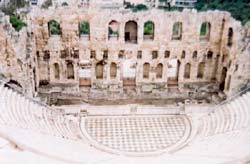
Ancient Greek performances occurred in amphitheatres, which were outdoor theatres carved into hillsides. While originally built with wood, many later theatres were stone-built, allowing the ruins to persist through the present day.
A few of the more notable Greek theatres include the Theatre Epidaurus, the Attic Theatre (‘Attic’ as in ‘Attican’), and the Theatre of Dionysus.
Most Greek amphitheatres seated 15,000 to 20,000 people, although more people often showed up. The audience was arranged in a strict classist manner, and sat in a semi-circular U-shape, in raked seating formed of steps that crawled up the hillside.
The Audience curved around the circular performance area, which was called the Orchestra. At the center of the Orchestra was the Thymele, an altar used in ceremonies to honor the God, Dionysus.
Behind the Orchestra, on the side not occupied by the Audience, was the Skene, a sort of backdrop/costume house/properties room, from which the mechane, a crane-like machine used for special effects such as raising gods to the heavens, was anchored.
Who Ruined the Ruins?
Over 2,000 years after their creation, it is often startling to think that Greek Edifices still stand, in any manner of disrepair. The ruins seem to be a poetic reminder of entropy, decay, that everything must eventually fall to dust.
It is easy to assume that the buildings have crumbled of their own accord, that they are slowly sliding toward the earth with the sands of time.
It is true that earthquakes and fires have taken their bites of the Greek structures. But unfortunately, the destruction of these stone creations has much less to do with time and the natural order than it has to do with men, who did not appreciate these edifices as a special legacy of an extremely special civilization.
As the Romans rose in power and the Greeks declined, the Romans sought to wrestle Greece from the Greeks, often commandeering Greek buildings and rebuilding them in a more Roman fashion, or, during the course of the Roman and Celtic invasions, simply destroying buildings with no idea of the legacy that might be left for the world, thousands of years in the future.
As polytheism was overtaken by Christianity, the Crusades plagued the past, working to wipe out memories of polytheism, by destroying Greek temples, or altering them to adapt them to Christian purposes. Again, it is unlikely that this was done with the malicious intent of covering the past, so much as with a sense of progress, of building the world for the swell of Christianity.
Likewise, Muslim jihads have subjected the Greek temples to the destructions of wars, and the alterations of a new faith.
There are, however, efforts to restore the ruins, such as the massive Akropolis restoration project which was undertaken in the 1970s.
In the end, it will never be possible to accurately return the Greek structures to their original states, however it may be possible to protect them from further damage; and the ruins are certainly worth appreciating while they last.
Join us soon for another Feature.