

Feature – Alfred Hitchcock
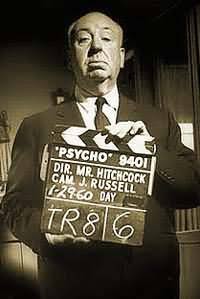
The acknowledged master of the thriller genre he virtually invented, Alfred Hitchcock was also a brilliant technician who deftly blended sex, suspense and humor. He began his filmmaking career in 1919 illustrating title cards for silent films at Paramount’s Famous Players-Lasky studio in London. There he learned scripting, editing and art direction, and rose to assistant director in 1922. That year he directed an unfinished film, No. 13 or Mrs. Peabody .
His first completed film as director was The Pleasure Garden (1925), an Anglo-German production filmed in Munich. This experience, plus a stint at Germany’s UFA studios as an assistant director, help account for the Expressionistic character of his films, both in their visual schemes and thematic concerns. The Lodger (1926), his breakthrough film, was a prototypical example of the classic Hitchcock plot: an innocent protagonist is falsely accused of a crime and becomes involved in a web of intrigue.
An early example of Hitchcock’s technical virtuosity was his creation of “subjective sound” for Blackmail (1929), his first sound film. In this story of a woman who stabs an artist to death when he tries to seduce her, Hitchcock emphasized the young woman’s anxiety by gradually distorting all but one word “knife” of a neighbor’s dialogue the morning after the killing. Here and in Murder! (1930), Hitchcock first made explicit the link between sex and violence.
The Man Who Knew Too Much (1934), a commercial and critical success, established a favorite pattern: an investigation of family relationships within a suspenseful story. The 39 Steps (1935) showcases a mature Hitchcock; it is a stylish and efficiently told chase film brimming with exciting incidents and memorable characters. Despite their merits, both Secret Agent (1936) and Sabotage (1936) exhibited flaws Hitchcock later acknowledged and learned from. According to his theory, suspense is developed by providing the audience with information denied endangered characters. But to be most effective and cathartic, no harm should come to the innocent as it does in both of those films. The Lady Vanishes (1938), on the other hand, is sleek, exemplary Hitchcock: fast-paced, witty, and magnificently entertaining.
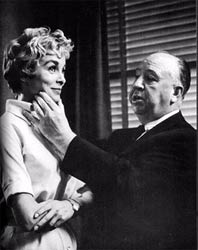
Hitchcock’s last British film, Jamaica Inn (1939), and his first Hollywood effort, Rebecca (1940), were both handsomely mounted though somewhat uncharacteristic works based on novels by Daphne du Maurier. Despite its somewhat muddled narrative, Foreign Correspondent (1940) was the first Hollywood film in his recognizable style. Suspicion (1941), the story of a woman who thinks her husband is a murderer about to make her his next victim, was an exploration of family dynamics; its introduction of evil into the domestic arena foreshadowed Shadow of a Doubt (1943), Hitchcock’s early Hollywood masterwork. One of his most disturbing films, Shadow was nominally the story of a young woman who learns that a favorite uncle is a murderer, but at heart it is a sobering look at the dark underpinnings of American middle-class life. Fully as horrifying as Uncle Charlie’s attempts to murder his niece was her mother’s tearful acknowledgment of her loss of identity in becoming a wife and mother. “You know how it is,” she says, “you sort of forget you’re you. You’re your husband’s wife.” In Hitchcock, evil manifests itself not only in acts of physical violence, but also in the form of psychological, institutionalized and systemic cruelty.
Hitchcock would return to the feminine sacrifice-of-identity theme several times, most immediately with the masterful Notorious (1946), a perverse love story about an FBI agent who must send the woman he loves into the arms of a Nazi in order to uncover an espionage ring. Other psychological dramas of the late 1940s were Spellbound (1945), The Paradine Case (1948), and Under Capricorn (1949). Both Lifeboat (1944) and Rope (1948) were interesting technical exercises: in the former, the object was to tell a film story within the confines of a small boat; in Rope, Hitchcock sought to make a film that appeared to be a single, unedited shot. Rope shared with the more effective Strangers on a Train (1951) a villain intent on committing the perfect murder as well as a strong homoerotic undercurrent.
During his most inspired period, from 1950 to 1960, Hitchcock produced a cycle of memorable films which included minor works such as I Confess (1953), the sophisticated thrillers Dial M for Murder (1954) and To Catch a Thief (1955), a remake of The Man Who Knew Too Much (1956) and the black comedy The Trouble with Harry (1955). He also directed several top-drawer films like Strangers on a Train and the troubling early docudrama (1956), a searing critique of the American justice system.
His three unalloyed masterpieces of the period were investigations into the very nature of watching cinema. Rear Window (1954) made viewers voyeurs, then had them pay for their pleasure. In its story of a photographer who happens to witness a murder, Hitchcock provocatively probed the relationship between the watcher and the watched, involving, by extension, the viewer of the film. Vertigo (1958), as haunting a movie as Hollywood has ever produced, took the lost-feminine-identity theme of Shadow of a Doubt and Notorious and identified its cause as male fetishism.
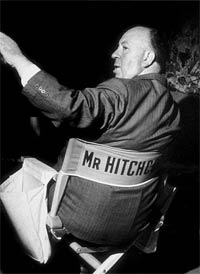
North by Northwest (1959) is perhaps Hitchcock’s most fully realized film. From a script by Ernest Lehman, with a score (as usual) by Bernard Herrmann, and starring Cary Grant and Eva Marie Saint, this quintessential chase movie is full of all the things for which we remember Alfred Hitchcock: ingenious shots, subtle male-female relationships, dramatic score, bright technicolor, inside jokes, witty symbolism and above all masterfully orchestrated suspense.
Psycho (1960) is famed for its shower murder sequence a classic model of shot selection and editing which was startling for its (apparent) nudity, graphic violence and its violation of the narrative convention that makes a protagonist invulnerable. Moreover, the progressive shots of eyes, beginning with an extreme close-up of the killer’s peeping eye and ending with the open eye of the murder victim, subtly implied the presence of a third eye the viewer’s.
Later films offered intriguing amplifications of his main themes. The Birds (1963) presented evil as an environmental fact of life. Marnie (1964), a psychoanalytical thriller along the lines of Spellbound showed how a violent, sexually tinged childhood episode turns a woman into a thief, once again associating criminality with violence and sex. Most notable about Torn Curtain (1966), an espionage story played against a cold war backdrop, was its extended fight-to-the death scene between the protagonist and a Communist agent in the kitchen of a farm house. In it Hitchcock reversed the movie convention of quick, easy deaths and showed how difficult and how momentous the act of killing really is.
Hitchcock’s disappointing Topaz (1969), an unwieldy, unfocused story set during the Cuban missile crisis, was devoid of his typical narrative economy and wit. He returned to England to produce Frenzy (1972), a tale much more in the Hitchcock vein, about an innocent man suspected of being a serial killer.
His final film, Family Plot (1976), pitted two couples against one another: a pair of professional thieves versus a female psychic and her working-class lover. It was a fitting end to a body of work that demonstrated the eternal symmetry of good and evil.
Join us soon for another Feature.