

Feature – The Ancient Olympic Games
The Olympic Games have not always been about skintight lycra suits and nifty silver sneakers. Did you know that when the Games started the athletes were mainly in the nude?
Many people believe that the Games began in 776BC but there is some evidence to suggest that celebrations and games took place as early as 10th or 9th century BC.
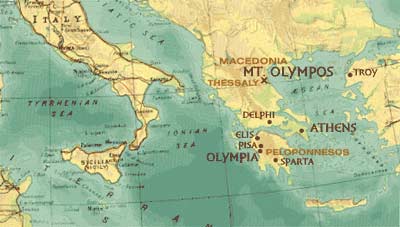
The Games originally formed part of the celebration festivities for the god Zeus. In Greek Mythology, the home of the Greek gods and goddesses was Mt. Olympus. This mountain is the tallest in Greece with an elevation of 2917 metres (9570 feet) and is situated in the north of the country, near the city of Ellis.
The religious festival consisted of many different events with the only actual athletic race being a 600 feet long running race known as the stadion race. In the year 776BC, this race was won by a local cook called Koroibos.
It is widely believed that the stadion race remained the only actual game for the first 13 festivals, which were held every 4 years. Men from all over Greece came to compete and, in those days, the Greek World spread to Iberia (Spain) and the Black Sea (Turkey) so some men had to travel for many miles before they even got to Olympia.
The Men’s Club
We say men. And we mean it. There were no women athletes allowed at the Games and women were actually banned from even watching the Games. But there is some evidence to show that young unmarried girls competed in a foot race in honour of the goddess Hera (the wife of Zeus). These young girls were allowed to watch the men’s races. Complicated, isn’t it?
At the four yearly festivities, politics were discussed as well as military victories ad alliances. It was a good forum to discuss all of these topics, as it was a large assembly of men from all over Greece.
There was a truce assigned to the Olympic Games so that no invasion or military intrusion could take place during the festival. Runners were sent out to all the corners of the Greek World to announce the Olympic Truce, which protected all who took part in the Games from athletes to spectators, visitors and official embassies. Any violation of the Olympic Truce meant that there was a fine paid to Zeus.
More Games
The Games really became ‘games’ when the festivities expanded to allow more events, which meant rather than the games being over in one morning they went on for 3 whole days, with 2 more days being taken up with the religious festivities. These new events included boxing, wrestling, javelin, discus, running, jumping, riding and chariot racing.
There was also the Pankration event, which included a combination of boxing and wrestling and was extremely vicious to watch with many of the outlawed moves of today quite acceptable (being kicked in the belly for example).
And finally, there was the Pentathalon, which included discus, javelin, jump, running and wrestling.
Oh, and there was singing too! Singers from all over Greece were sent to take part in the choir competitions.
Free Men
Athletes were men from all over the Greek World who were free. That means that they were never to have been slaves and if they had ever done anything to upset the gods, they were not allowed to become involved in the Games. The men had to take part in 10 months of training at Olympia and were probably very rich as no poor man would have been able to take so much time off work or fund their trip to Olympia.
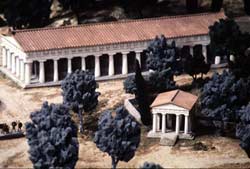
When the men arrived in the town of Ellis they spent their 10 months of training and had to follow strict rules with judges monitoring them. The men would spend a month together in a gym (known as a palaestra) that had a sand floor and they were fed with only fresh cheese and water at mealtimes.
When the time for the Games began, every athlete would go the sanctuary of Zeus and sacrifice a pig to Zeus and a black ram to Pelops.
Points make Prizes
There could be only one winner per event and the lucky man originally received a branch cut from an olive tree. This olive tree was one of many in Hera’s grove and the branch was cut with a golden scythe by a young boy whose parents were still living.
Prizes did get a bit more material as time went on and included bronze tripods, woolen cloaks, olive oil, shields and a free meal for every day of their lives at the City Hall.
Ancient to Modern
We mentioned nudity early on in this article and there definitely was some nudity at the early Games. Some say that only the runners were nude as this helped them to run faster but some others believe that most of the contestants were nude. Good thing that it is always warm in Greece!
The idea of the Olympic Flame came from the eternal flame at Hera’s temple and is the hallmark of the modern games today. In the ancient times however, the only actual torches were used in some foot races.
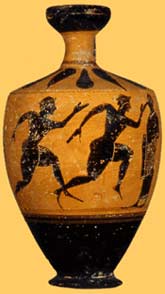
The Marathon event did not actually become an Olympic event until 1896 but it does commemorate an ancient runner. This runner carried news of the Persian landing at Marathon. He ran for 149 miles and reportedly collapsed and died of exhaustion following his run!
As news of the Games spread and the prizes got better, more and more men from all over Greece came to Olympia to contend in the events. The Games became such a part of Greek life that people used to say that they were born in the third year of the twentieth Olympiad, for example!
In the year 393 AD the Roman Emperor Theodosius banned the Games. This was following the conversion of many people to Christianity.
Frenchman Baron Pierre de Coubertin reintroduced the Games in 1894. The games were to be held in Paris but delegates from over 34 countries convinced him to move the games to Athens.
We have enjoyed the Olympic Games ever since and with the introduction of more events and the Winter Olympics; athletes from all over the world compete for the honour of the Gold, Silver and Bronze medals.
Join us soon for another Feature.