
Einstein
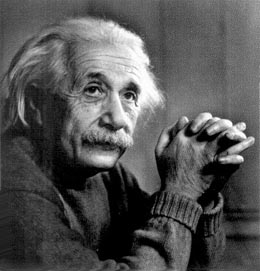
Today the very word ‘Einstein’ is synonymous with genius. Therefore, you might be relieved to learn that Einstein hated school, finding it boring and unimaginative. He actually left school at age 15, when his family moved to Milan from his boyhood hometown of Munich .
Later on he attended the Swiss Federal Institute of Technology in Zurich, but he didn’t like it there either. He often skipped classes in order to carry out physics experiments on his own, or to play his violin. He graduated in 1900, at the age of 21, and went to work in a patent office, where he stayed for nearly a decade.
But here’s where it gets intimidating. While working at the patent office, Einstein developed a series of theories that would fundamentally alter humanity’s understanding of nature and the universe – and did it all after work hours! His first great year was 1905, when he was 26. In that one year alone, he published a paper on Brownian motion (ie the movement of particles in water) developed his theory of photoelectric effect (that light is contained in individual particles rather than a single mass), and most importantly of all, discovered the theory of relativity.
This theory states that space and time are not absolute, but vary according to the movements of bodies within space and time. Later in 1905, Einstein extended his theory to include the equation E=mc2. This means that the energy content of a body is equal to the mass of the body, multiplied by the speed of light, squared.
At the time, not many people believed or understood Einstein’s new theories – they contradicted older, generally accepted theories. Also , as an unknown working on his own, Einstein lacked credibility. Today though, historians refer to 1905 as Einstein’s ‘Annus Mirabilis’ – ‘Miracle Year.’
Einstein did attract some support at the time, notably from German physicist Max Planck. With Planck’s patronage, Einstein worked at a number of German universities in the years leading up to World War One. Finally, in 1914, he became director of Kaiser Wilhelm Institute for Physics in Berlin. Over the next two decades, Einstein’s reputation grew, and he won the Nobel Prize for Physics in 1921.
Einstein used his new-found fame as a platform to promote social causes, notably pacifism and zionism. As a result, he became the target of right wing and nationalist groups in Germany. Alarmed by Hitler’s rise to power in 1933, he fled to the United States, and eventually taught at Princeton University for over 20 years.
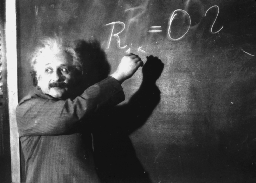
Throughout the 1930s, German aggression grew, to Einstein’s dismay. In 1939, he joined with a group of other physicists to urge President Franklin D Roosevelt to start research on developing nuclear weapons. Einstein was worried that the Germans might develop nuclear weapons first, and would then have no qualms about using them.
Roosevelt agreed with Einstein, setting up the Briggs Committee to study uranium chain reactions. This eventually grew into the Manhattan Project , which led to the development of the first nuclear bomb. Einstein did not participate in the actual development of nuclear weapons, and condemned the bombing of Hiroshima, saying that it would never have happened if Roosevelt had still been alive.
He was concerned about the implications nuclear weapons had for the future of the world, and expressed regret at urging Roosevelt to build them. He added that Nazi Germany’s aggression provided some justification.
After World War Two, Einstein remained active in social causes, especially world governme nt and disarmament. He also declined an offer to become the first president of Israel, and died in Princeton in 1955 at the age of 75. His concern for the wellbeing of humanity made him a great man as well as a great scientist.