

Geronimo
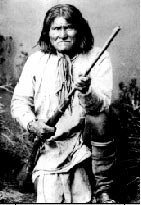
(1829-1909)
Apache warrior and hero
Geronimo was born Goyathlay (One Who Yawns) in Arizona, grandson of a chief of the Nedni band of the Chiricahua Apache. His father married a Bedonkohe Apache and joined her tribe, forfeiting his hereditary right as leader. Geronimo was never a chief. He was in fact, a medicine man, a seer and a spiritual and intellectual leader both in and out of battle. The Apache chiefs depended on his wisdom.
To the Chiricahua Apache, Geronimo embodied the essence of Apache values – courage, diligence and aggressiveness – qualities that for years kept them relatively safe from the increasing white encroachment in Arizona and New Mexico.
The Chiricahuas were nomadic, following game and farming in the warmer months. But when times were tough and food was scarce raids on other tribes was the way of life, and considered honourable.
By the time white European settlers began arriving in the area, the Spanish had been entrenched for years. They were always looking for Indian slaves and Christian converts. One of the most pivotal moments in Geronimo’s life was in 1858 when he returned home from a trading excursion into Mexico. He found his wife, his mother and his three young children murdered by Spanish troops from Mexico. This reportedly caused him to have such a hatred of the whites that he vowed to kill as many as he could. From that day on he took every opportunity he could to terrorize Mexican settlements. Prior to this event, Geronimo had been considered more a holy man than a warrior, but as a result of his loss he often spoke of his hatred for whites. He is said to have had magical powers that enabled him to see into the future, walk without creating footprints, being invulnerable to bullets, and even able to prevent dawn from rising to protect his people.
Geronimo’s “white name” is thought to have come as a result of his fearless and resourcefulness as a warrior. While leading a charge against Mexicans they began to shout “Geronimo!” seeking help from their patron saint, Jerome, or Geronimo in Spanish. Emerging conqueror over the Mexicans, the warriors bestowed the name of Geronimo on their fearless leader. To this day the name remains a battle cry.
The army tried to place all the Chiricahua on reservation in 1876, but Geronimo fled to Mexico and escaped capture for a decade. Sensationalised press reports exaggerated Geronimo’s activities, they had Geronimo everywhere and doing everything, often at the same time. This made him the most feared and famous Apache. It wasn’t all myth however. His name was associated with terror in the Southwest and ultimately it took more than 5,000 soldiers and 500 scouts to track down Geronimo and his followers.
He finally surrendered after hearing his people were being sent East. He was the very last renegade Indian to surrender to white authority. Geronimo was sent to a reservation in Florida for two years, where many died of malaria or tuberculosis. Geronimo longed to return to his beloved Arizona, but that was not to be so. He was to make another stop in Alabama before finally being placed on a reservation in Oklahoma, which at least bore a climate more similar to that of the Southwest. It was here, at Fort Sill, that he spent the last 14 years of his life.
As the years passed, stories of Geronimo’s warriors ferocity made him a legend that fascinated non-Indians and Indians alike. In his old age, Geronimo learned a little English and how to write his name. He became very enterprising in his ability to market himself and his legacy, selling buttons from his coat for a quarter apiece, his hat for five dollars or bows and arrows that he made. For 50 cents, he would sign his name. If asked he would show off his battle wounds with pride. His appearances at public events generated much interest, and in 1905 he was quite the sensation when he appeared in President Roosevelt’s inaugural parade. He also made personal appearances at places like Oklahoma fairs, the Exposition in Omaha in 1898, the Pan-American Exposition in Buffalo in 1901, and the St. Louis World’s Fair in 1904.
Despite making the rounds as an “attraction,” Geronimo was never allowed to return to Arizona. As an old man, he remained a crack shot, and he enjoyed good health well into his 80s.
Geronimo also drank, sometimes to excess and this ultimately was his demise. On a cold night in February of 1909, drunk, he fell off his horse and lay undiscovered on the cold ground. This brought on pneumonia and he died a few days later.