
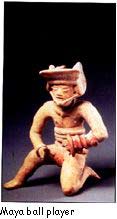

Feature – Mayans -The sport of life & death
Imagine if the loser of a football match today was sacrificed? This was a common occurrence in the Mayan time for the players of a ball game called Pok-a-Tok.
The Mayan people were very superstitious and believed that the only way to keep the gods happy was to sacrifice a valuable human – a ball player.
So who were these players that could possibly be sacrificed if their team didn’t win? Only nobility could participate in the game, and the numbers of players varied from region to region. The captain of the defeated team was the one chosen to be sacrificed.
The Court
The court was shaped like a capital “I”, it was also a symbol of a city’s wealth and power. Chichen Itza is the largest known Mayan ball court that has been found it is larger than our football fields.
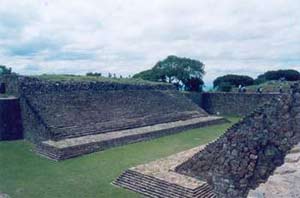
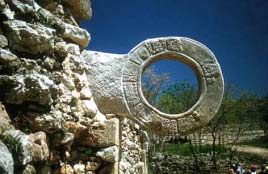
Two sloping parallel walls that allowed the ball to bounce upwards and remain airborne for longer framed the pitch, which was usually a plaster or stone floor. The walls also had three round marker-discs several meters above the ground that sat at right angles. The player had to try to get the ball through these discs – scoring was considered such a feat that it usually ended the game. At the base of the court walls was a bench that was decorated with pictures of human sacrifices.
The Ball
The ball that was used in the game was a very bouncy rubber ball, made from a native plant – the rubber tree. All the balls were hollow making them lighter and able to bounce higher. Some balls had human skulls as the center and the rubber strips were wound around to form a ball. The skulls were said to have symbolized the life and death aspect of the sport.
Now this doesn’t sound so dangerous, but the size of the ball varied from the small size of a baseball to a size larger than a beach ball. The ball could weigh as much as a watermelon (about 8 pounds/ 3.6 kilos). When you have a really bouncy ball that heavy coming towards you – the players had to be careful not to break bones.
The Player
The player’s uniform not only had to protect the player from the ball, but had to allow for quick movement. The players wore Yuguitos (little yoke) to protect knees, wrists and help to hit the ball. A Yoke, made from fabric, was worn around the waist to protect the body and deflect the ball. Also, Manoplas (handstones) were used to hit the balls.
Players had to make sure that they kept the ball in the air by using their hips, body, legs or arms, touching the ball with their hands or feet was not allowed. They knocked the ball off walls or each other.
It was said that if a player scored a goal, he was entitled to take the jewellery of everyone in the audience. While the winners were showered with prizes and riches, don’t forget the price the losers had to pay. Luckily for most sportsmen today the price of losing isn’t so high.
Join us soon for another Feature.