

Feature – Practically Unsinkable, Practically Molly
Who is the Unsinkable Molly Brown? Would it startle you to hear that Molly Brown never existed?
The legend of the Unsinkable Molly Brown was born in a Broadway play called—“The Unsinkable Molly Brown.” The real Molly Brown was a woman named Margaret, who claimed to have survived the disaster out of “typical Brown luck. We’re unsinkable.”
Margaret “Maggie” Tobin was a poor girl who grew up in Hannibal, Missouri (in the United States). She lived in a one-bedroom shack with her five siblings and her father, John, an Irish emigrant. Although she had few possessions, she had enough spunk and imagination to keep herself (and the people around her) occupied indefinitely.
Maggie was a notorious story-teller. She claimed to be a childhood friend of Mark Twain (who was also from Hannibal), and, when she and her brother Daniel left to seek their fortune in gold-mining, their wagon train had been attacked and robbed by the infamous Jesse James.
The excitement of the gold rush suited Maggie. She picked out her very own mining engineer, wooed him and married him. Maggie and James J. “J.J.” Brown had two children, Lawrence Palmer (“Larry”) and Catherine Ellen (“Helen”). Despite their ties to the mining industry, Maggie and J.J. were not much better off than Maggie had been as a child, and lived in a two room log cabin in Leadville, Colorado.
Opportunity finally struck when J.J. was invited to help the Ibex mining company solve the deadly problem of mine cave-ins. His engineering expertise helped to open the world’s richest gold strike, suddenly transforming the Brown family into a spectacularly wealthy family.
Suddenly presented with more money than she could handle, Maggie was ready to play. The Browns bought a mansion in a chic neighbourhood in Denver, Colorado, and Maggie began her attempts to infiltrate the snobby social scene of Denver socialites.
Although her family was now one of the wealthiest in the country, Molly and J.J. were excluded from the scene, labelled as nouveau rich (a derogatory name for someone who has not been born wealthy, but has recently acquired money…and not yet learned to handle it gracefully). Not a woman to be so easily defeated, Maggie pushed her way into the scene all the same, wearing the best clothing, and throwing the most lavish parties.
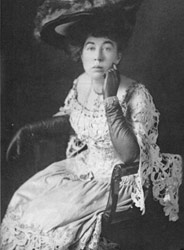
Maggie studied at New York’s Carnegie Institute. She and her family began travelling the world, learning about art and culture, and making impressive friends to show off to the snobs back in Denver. She corresponded with Edward, Duke of Windsor. She was a close friend of Princess Dolgorouki, an exiled Russian princess. Maggie claimed to know “everyone worth knowing from Moscow to Bosphorus.”
Still, with Maggie as outspoken as she was, and the known lower-class backgrounds of both J.J. and Maggie, the Denver elite were not fully ready to accept them.
The Browns finally earned a listing in the Denver social directory, but were never invited into the “Sacred 36,” the Denver equivalent of the cool kids club.
While on a European tour in 1912, Maggie received word that her grandson, Lawrence Palmer, Jr., was ill. Desperate to make it home to his bedside, Maggie immediately booked a first-class ticket on the famous ship, the RMS Titanic.
Maggie was up late finishing a book in her cabin when something crashed at the window above her, throwing her to the floor. A nearly-hysterical man in the hall screamed that she needed to get her life-jacket.
Maggie raced to the deck where she was dropped 4 feet to land in a lifeboat.
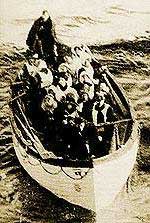
When the boat was lowered to the icy sea below, there were 14 women in the boat, along with an incessantly pessimistic quartermaster who graphically insisted that the sinking Titanic would suck them underwater no matter how hard they rowed away.
Not willing to be told to give up, Maggie usurped command of the lifeboat, and began to paddle away, enlisting another young woman on board to help her row. Using the rowing to keep her fellow passengers mentally occupied and physically warm, Maggie waited out the rescue ship. It was probably her working class background in hard labour and her militant spunk that kept her, and the 14 other people on her life boat, alive.
Maggie’s level-headed and ambitious life-saving efforts did not end on the lifeboat. When the German ship Carpathia finally arrived at 4:30 am, Maggie helped to organize the massive rescue efforts.
She composed survivor lists and had them radioed to the families. She even created a committee of wealthy survivors to raise money for the many destitute victims of the tragedy. By the time they reached New York, they had raised nearly $10,000 in pledges.
And that, my friends, is giving back to the Community.
Join us soon for another Feature.