
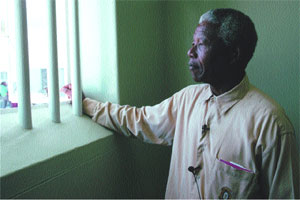

Nelson Rolihlahla Mandela – Part 2
From the first day, Nelson had protested about being forced to wear short trousers. Coloured prisoners were given long trousers, but black prisoners were given short trousers to remind them that they we boys. Nelson demanded to see the head of the prison and made a list of complaints. The warders ignored his protests, but by the end of the second week, Nelson found a pair of old khaki trousers unceremoniously dumped on the floor of his cell. Before putting them on he checked to see if his comrades had been issued trousers as well. They had not, and so Nelson told the warder to take them back.
In jail, all prisoners are classified by the authorities as one of four categories: A, B, C, or D. A is the highest classification and confers the most privileges; D is the lowest and confers the least. All political prisoners, or what the authorities called “security prisoners,” were automatically classified as D on admission. The privileges affected by these classifications included visits and letters, studies, and the opportunity to buy groceries and incidentals all of which are the lifeblood of any prisoner. It normally took years for a political prisoner to raise his status from D to C.
The classification system was corrupt and demeaning, another way of repressing prisoners in general and political prisoners in particular. Although Nelson criticized it, he could not ignore it: the classification system was an inflexible feature of prison life. The classifications generally ran parallel to the length of the sentence. For an eight year sentence, they would generally be classified as D for the first two years, C for the next two, B for the following two, and A for the last two. But the prison authorities wielded the classification system as a weapon against political prisoners, threatening to lower their hard-won classifications in order to control behaviour.
Though Nelson had been in prison for nearly two years before he was taken to Robben Island, he was still in D Group when he arrived. While he desired the privileges that came with higher classifications, he refused to compromise his conduct. The fastest way to raise one’s classification was to be docile and not complain. This was not Nelson’s nature. Every six months, prisoners were called before the prison board to have their classifications evaluated. The board preferred to act as a political tribunal rather than a mere evaluator of behaviour, with the officials asking Nelson questions about the ANC and his beliefs. Nelson later realized that this was simply a technique on the part of the authorities to glean information from the prisoners, so they agreed among themselves not to discuss politics with the prison board.
As a D Group prisoner, he was entitled to have only one visitor, and to write and receive only one letter every six months. This was one of the hardest restrictions of the prison system, but it was one of the facts of prison life. Visits and letters were restricted to “first degree” relatives. This was a restriction the black prisoners not only found irksome but racist. The African sense of immediate family is far different from that of the European or Westerner. The family structures are larger and more inclusive; anyone who claims descent from a common ancestor is deemed part of the same family.
The authorities abused the restriction. The anticipation of mail was overwhelming. Mail call took place once a month, and sometimes six months would go by without a letter. The authorities would withhold mail out of spite. Warders teased Nelson that there was a letter for him, but wouldn’t give it to him. No explanation of why, or whom the letter was from. Afterward, he would protest through the proper channels, and sometimes get it. Even then the letter was so heavily censored that not much more than the salutation was left. The island’s censors would black out the offending passages in ink, but they later changed this when they realized the prisoners could wash away the ink and see what was underneath. They began to use razors to slice out whole paragraphs. Since most letters were written on both sides of a single piece of paper, the material on the other side would also be excised. They seemed to relish delivering letters in tatters. The censorship delayed the delivery of mail because warders, some of whom were not proficient in English, might take as long as a month to censor a letter.
Outgoing letters were censored as well; they were often as cut up as the letters received.
At the end of August, after Nelson had been on the island less than three months, the authorities informed him that he would have a visitor the following day. From the moment his wife Winnie learned Nelson had been brought to the island, she had been trying to arrange a visit. As a banned person, Winnie had to receive a special dispensation from the minister of justice, for she was technically not permitted to communicate with him.
Even with the permission from the authorities, visiting Robben Island was not an easy proposition. Visits were a maximum of thirty minutes long, and political prisoners were not permitted contact visits, in which the visitor and prisoner were in the same room. Visits did not seem to be planned in advance by the authorities. One day, they would contact your wife and say, “You have permission to visit your husband tomorrow.” This was enormously inconvenient, and often had the effect of making visits impossible. If a family member was able to plan a visit in advance, the authorities would sometimes deliberately delay issuing a permit until after the plane had departed. Since most of the men’s families lived far from the Cape and had very little money, visits by family members were often far beyond their means. Some men who came from poor families did not see their wives for many years at a time, if at all.
Nelson later discovered Winnie had recently received a second banning order and had been terminated from her job at the Child Welfare Office as a result. The police searched her office shortly before she was fired. The authorities were convinced that Winnie was in secret communication with Nelson. Winnie loved her job as a social worker. It was the hands-on end of the struggle: placing babies with adoptive parents, finding work for the unemployed and medical help for the uninsured. The banning and harassment of Nelson’s wife greatly troubled him. His powerlessness gnawed at him.
One morning Nelson and his fellow political prisoners were transported by truck to a lime quarry. The commanding officer met them and told them that the work they would be doing would last six months and afterward they would be given light tasks for the duration of their terms. His timing was considerably off. They remained at the quarry for the next thirteen years!
Near the quarry, the dirt road diverged, and to the right the general prisoners trooped off to the rock quarry. This crossroads was later to become an important site of communications with them.
The sun’s rays reflected off the lime into the prisoners’ eyes. The glare hurt their eyes and made it difficult to see. After the first few days at the quarry, they made an official request for sunglasses. The authorities refused. During the following weeks and months, they requested sunglasses again and again. But it took almost three years before they were allowed to have them, and that was only after a sympathetic physician agreed that the glasses were necessary to preserve their eyesight. Then they had to purchase the glasses themselves.
For Nelson, such struggles for sunglasses, long trousers, study privileges, equalized food were corollaries to the struggle waged outside prison. The campaign to improve conditions in prison was part of the apartheid struggle. It was, in that sense, all the same; he fought injustice wherever he found it, no matter how large, or how small, and he fought injustice to preserve our his humanity.
As a lawyer, Nelson began representing prisoners against charges they received within the prison system and when making charges against the warders.
The first few years on the island were difficult times both for the ANC organization outside and those in prison. After Rivonia, much of the movement’s underground machinery had been destroyed. Its structures had been discovered and uprooted; those who were not captured were scrambling to stay one step ahead of the enemy. Virtually every one of the ANC’s senior leaders was either in jail or in exile. In the years after Rivonia, the ANC’s External Mission, formerly responsible for fund-raising, diplomacy, and establishing a military training program, took up the reins of the organization as a whole. The External Mission not only had to create an organization in exile, but also had the even more formidable task of trying to revitalize the underground ANC inside South Africa.
The state had grown stronger. The police had become more powerful, their methods more ruthless, their techniques more sophisticated. The South African Defence Force was expanding. The economy was stable, the white electorate untroubled. The South African government had powerful allies in Great Britain and the United States who were content to maintain the status quo.
The ANC formed its own internal organization on the island. Known as the High Command, or more officially, the High Organ, it consisted of the most senior ANC leaders on Robben Island, the men who had been members of the National Executive Committee: Walter Sisulu, Govan Mbeki, Raymond Mhlaba, and Nelson Mandela. Nelson served as the head of the High Organ.
The High Organ would not try to influence external ANC policy as they had no reliable way of evaluating the situation in the country, and concluded it would neither be fair nor wise to offer guidance on matters about which we they uninformed. Instead, they made decisions about such matters as prisoners’ complaints, strikes, mail, food all of the day-to-day concerns of prison life.
In the first few years on the island, the High Organ also acted as a representative committee for all the political prisoners in Nelson’s section. In 1967, they organized a petition demanding better treatment that was signed by virtually everyone, including members of the PAC, the Unity Movement, and the Liberal Party.
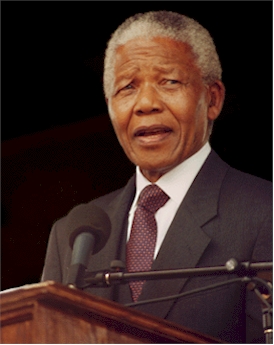
Even while imprisoned, Nelson was active in political organisations and a fundamental human rights activist.
As antiapartheid pressure mounted within and outside South Africa, the South African government, led by President F. W. de Klerk, began to dismantle the apartheid system in the early 1990s. The year 1990 brought a National Party government dedicated to reform and also saw the legalization of formerly banned black congresses and the release of imprisoned black leaders.
Released on 11 February 1990, Mandela plunged wholeheartedly into his life’s work, striving to attain the goals he and others had set out almost four decades earlier. In 1991, at the first national conference of the ANC held inside South Africa after being banned for decades, Nelson Mandela was elected President of the ANC while his lifelong friend and colleague, Oliver Tambo, became the organisation’s National Chairperson.
Nelson Mandela has never wavered in his devotion to democracy, equality and learning. Despite terrible provocation, he has never answered racism with racism. His life has been an inspiration, in South Africa and throughout the world, to all who are oppressed and deprived, to all who are opposed to oppression and deprivation.
In a life that symbolises the triumph of the human spirit over man’s inhumanity to man, Nelson Mandela accepted the 1993 Nobel Peace Prize on behalf of all South Africans who suffered and sacrificed so much to bring peace to their land.
In 1994 the country’s constitution was rewritten and free general elections were held for the first time in its history, and with Nelson Mandela’s election as South Africa’s first black president, the last vestiges of the apartheid system were finally outlawed.
He was inaugurated as the first democratically elected State President of South Africa on 10 May 1994- June 1999
Nelson Mandela retired from Public life in June 1999.
Reference: Long Walk to Freedom: The Autobiography of Nelson Mandela
Join us for another Feature article soon