

Feature – Polynesia
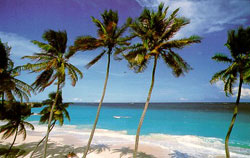
The South Pacific is a mystical place and one that many only dream of visiting. Islands such as Tahiti, the Hawaiian Islands and Bali are carved in our minds as idyllic places to visit. And they are just that! But there is much more to the islands than beaches and hula dancers.
Early history
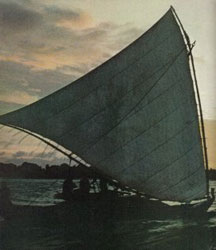
The history of the nomadic people that inhabited the various islands of the Pacific is speculative. It is thought that the people originated in South East Asia some 3000 or 4000 years ago. For some reason these people decided to travel across the ocean and in so doing, settled the beautiful islands they came across.
As many of the cultures and traditions of the islands are extremely similar, as well as the general ‘look’ of the people that inhabit them, it stands to reason that these settlers started off in the same area of the world.
The Pacific Ocean is the largest and deepest of any water mass on the globe and it is dotted with thousands of islands as far apart as Hawaii, New Zealand (Aotearoa) and Eater Island (Rapa Nui). Indeed Polynesia literally means ‘many islands’.
The first settlers of the islands must have been skilled navigators and sailors as the islands cover around 16 million square miles of ocean.
The islands were initially ruled by chieftans and each island ‘race’ of Polynesians had similar traditions that involved human sacrifice.
It is said that some of the people from these islands left and went further afield, settling the Hawaiian Islands and some of these settlers in turn left Hawaii and founded New Zealand.
European Influence
Spaniard explorers first came across some of the islands in the 1500’s but did not settle as they were on the trade route from Peru to the Philippines and the islands were of no real interest or use to them.
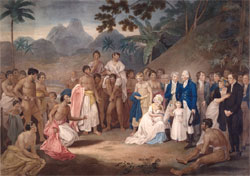
When the first European visitors arrived in the late 18th Century, they found stunning islands full of ‘noble savages’ with some very worrying religious beliefs – wouldn’t you be worried if you thought you might be the next human sacrifice?!
On their return to Europe, explorers such as Samuel Wallis (1767), Louis-Antoine de Bougainville (1768) and James Cook (1769) excited their colleagues and friends with talk of these exotic places.
Mutiny on the Bounty
The famous ship The Bounty set sail for the South Pacific and it was it on April 28th 1789 that the mutinous crew of the ship, led by Fletcher Christian set a small open boat adrift and waved goodbye to Captain William Bligh and his faithful crew members.
The mutineers sought refuge on the islands of Tahiti and Tubuai and those that didn’t escape to Pitcairn Island were rounded up by British law enforcers and made to face justice for their actions.
At this time large family groups ran the Polynesian islands and there was no actual leader as such. Since the Europeans had first set foot on the islands, families knew that the weapons they brought with them would be of benefit.
Despite trying to convince the explorers to trade their weapons they had no luck and it was not until the mutineers came to Tahiti that European weapons were properly introduced to the inhabitants.
The Pomare family was one of the largest of the Tahitian families and they secured the weaponry and services of the mutineers and so came to control the islands.
Paradise Lost
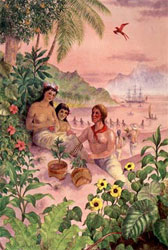
It wasn’t long before whalers and traders came to the islands and they developed business and personal relationships with the islanders. The islanders were much more relaxed than Europeans and the early visitors to the islands appreciated this way of life. They were fascinated to see the local women wander around with little on and definitely enjoyed their visits to paradise.
Natural immunity had not been developed against some of the diseases that the Europeans brought with them and as a result many islanders lost their lives to smallpox and other such epidemics.
Tales of ‘loose living’ and man-eating savages reached the ears of Protestant missionaries who settled on the islands in an attempt to educate the natives. The missionaries were a zealous lot and quickly prohibited any other religious practices than their own and tore local religious temples and monuments to the ground.
The population of the Polynesian islands dropped rapidly as a result of disease and missionary tyranny and life was very different for the islanders who survived with little cultural heritage left.
The French came to the islands in the 1800’s and overthrew the British and today many of the islands are still termed as French Polynesia.
Each island of the South Pacific is beautiful and each one retains its own individualism. Old cultures have been brought back and people can now appreciate the history of traditions and of their ancestors.
Join us soon for another Feature.