
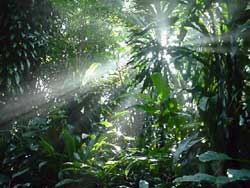

Feature – Singapore Wildlife
With over four million people packed and stacked into only 655 square kilometers, it is difficult to imagine that Singapore has any landscape other than pollution, concrete, and chrome. The truth, though, is that the concrete jungle that is modern Singapore has grown up out of another jungle, one millions of years old.
Tropical Rainforests
Tropical Rainforests occupy less than 6% of the planet, yet they are the most vital ecological system on Earth, producing over 40% of Earth’s oxygen and hosting well over half of the planets species of plants and animals.
It is difficult to imagine the scope of the rainforest’s importance.
More than one fourth of the pharmaceuticals in use today are derived from plants in the rainforest. Only 20 years ago, a child with leukemia had only a 20% chance of surviving the disease. However today, thanks to rosy periwinkle found in the tropical rainforest, a person with lymphocytic leukemia has a 99% chance that the disease will go into remission.
Over 1,400 varieties of tropical plants are believed to be potentional cures for cancer. And yet the compositions of only 0.1% of rainforest plant compounds are yet known. That means there are still 1000 times as many natural chemicals and medicines waiting to be explored.
Rainforests are a very interesting ecological system.
Because the plants grow so densely in the rainforest, the tree canopy cuts out almost all light before it hits the forest floor. Thus, all of the plants are scrambling over each other to reach to top of the forest. Very literally. Vines grow upward from the forest floor (sorry, tarzan! No swing!), snaking across the branches of other trees with sturdier trunks, often using tiny claws to gain a firm grip; some plants spiral around other plants, literally choking each other as they fight for sunlight. And then there are free-riding parasite-like plants, which take root high up in the branches of a tall tree.
The soil in the rainforest is very poor, often more sandy than mossy. So plants in the rainforest take their nutrients from dead and rotting plants and leaves on the forest floor. It’s sort of like how the human batteries were fed in The Matrix, only without the scary robots. Watch out! Cannibalistic plants!
Because rainforests appear to be so lush and alive, people often assume that the soil must be extremely rich. Thus, the rainforests are constantly being cut down so that the land can be used for farming. However, without the rich ecosystem of the rainforest, there is no more plant-waste to enrich the soil, and farmers are lucky if they get one good season of crops from ex-rainforest fields. Thus, farmers in some tropical areas have developed the sad habit of cutting down a new patch of rainforest each year for a new season of crops.
Rainforest deforestation is happening at a manic pace. An area the size of a football field, containing half a million trees, is cut down every second. Every second! Really, stop and think about that.
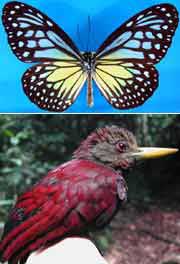
An average of 35 animal species become extinct every day, due to deforestation. And many species go extinct before they are even discovered! This is a really difficult idea to conceptualize. So here’s a little visual for you.
One.
Two.
Three.
Four.
Five.
Six.
Seven.
Eight.
Nine.
Ten.
Eleven.
Twelve.
Thirteen.
Fourteen.
Fifteen.
Sixteen.
Seventeen.
Eighteen.
Nineteen.
Twenty.
Twenty-one.
Twenty-two.
Twenty-three.
Twenty-four.
Twenty-five.
Twenty-six.
Twenty-seven.
Twenty-eight.
Twenty-nine.
Thirty.
Thirty-one.
Thirty-two.
Thirty-three.
Thirty-four.
Thirty-five.
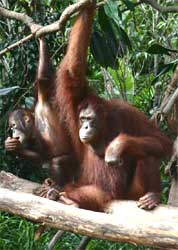
Thirty-five entire species, gone forever, every single day! That’s approximately 13,000 species pushed into extinction, every single year. Scientists estimate that at this rate, in 30 years we will have killed off over half of the species currently living on the planet.
This is faster than the extinction of the dinosaurs.
Between chlorophyll and concrete, which jungle thrives in Singapore?
Unfortunately, most of natural Singapore has been laid to waste, cut down, paved over. What remains are a series of parks and reserves, most of them more man-made than natural.
Singaporean Parks and Gardens
East Coast Park, a locals’ favourite, has become a sort of peoples playground, housing a variety of activities, from bowling to windsurfing. Marina South City Park is another popular hangout, whose main attractions are a giant sundial and disc sculptures, which revolve in a breeze best suited for kite-flying. Mount Faber is a popular destination for tourists, and provides a number of gorgeous views and lookouts.
Fort Canning Park is a site with a lot of history and cultural importance. Once used as the final resting place of many Malay rulers, the site remains sacred to Malasians. It has recently grown into a popular outdoor arts venue, hosting sculpture gardens, theatre events, and even ballet under the stars.
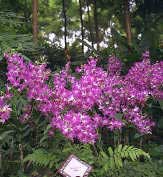
In addition to Chinese and Japanese gardens, there are a number of gardens showcasing a beautiful flower from the area: the orchid. Mandai Orchid Garden is the largest commercial orchid garden. The world’s largest orchid display however, featuring over 60,000 plants and orchids, can be found in the Singapore Botanic Gardens. Spread over a 52-hectare area, the Botanic Gardens combine manicured gardens with some of the last primary jungle to remain on the island.
The Bukit Timah Natural Reserve is one of two rainforests in the world within city boundaries. (The other is in Rio de Janeiro, Brazil). There are more plant species within this 164-hectare reserve than there are on the entire continent of North America! And of course, there are thousands of fascinating animals here, for example flying lemurs, mouse deer, the hard-to-spot pangolin, and long-tailed Macaques.
Jurong Bird Park is more of a zoo than a natural reserve, with landscaped enclosures housing an impressive 8,000 birds, from over 600 species, including penguins, flamingos, macaws, hornbills, and cockatoos. The Southeast Asian Birds aviary here, home to 100+ southeast asian birds, even goes so far as to simulate a daily tropical thunderstorm.
Underwater World is another animal park that simulates a natural environment, rather than actually relying on nature, in order to showcase animals. Most recently, Dolphin Lagoon has been built here for Indo-Pacific Humpbacked Dolphins (aka Pink Dolphins).
The Singapore Zoological Gardens is said to be one of the most beautiful zoos in the world. Rather than using cages, the zoo employs natural barriers such as moats and rock walls to house over 2,000 animals, including 40 endangered species. Despite being a poor replacement for nature, zoos play a vital role in preservation. Captive animal breeding programs are, in some cases, the only remaining defense against an animal’s extinction.
So there it is, mother nature invited back, on man’s terms. Singapore is on its way back to its roots, in a controlled return to the wild, natural world.
Join us soon for another Feature.