

Feature – Sir William Wallace
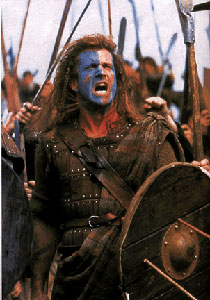
One of Scotland’s favourite sons, William Wallace is now known the world over thanks to the movie ‘Braveheart’.
Mel Gibson starred in and directed the movie that many historians panned as inaccurate and romantic claptrap. It is true to say however that ‘
Braveheart’ captured the hearts of many who watched it and a lot of people are now fascinated with the real William Wallace.
Because Wallace lived such a long time ago there are many different stories of how he came to be. The fact that he was a great leader means that there are even more stories and theories as to his adult life.
Wallace was born in January 1270 (though some dispute the month and indeed the year). The second son of a small landowner, the family lived in Ayrshire Scotland and many say that the family owned land near Ellerslie (which is now called Elderslie).
It seems that Wallace’s father Malcolm was a Scottish knight and his title was Sit Malcolm Wallace, Laird of Elderslie and Auchinbothie. Wallace’s mother was the daughter of the Sheriff of Ayr, Sir Hugh Crawford.
Although Wallace was the son of a laird this did not mean that he had a particularly grand life but it was a lot better than the life portrayed in the movie.
Scotland was at peace and had financial stability thanks to the 20-year reign on the Scottish throne of Alexander III.
Wallace, along with his older brother Malcolm would have been taught the martial arts of the time, horsemanship and swordsmanship and he is said to have been a mighty figure of 6 and a half feet tall.
This was a huge height to reach in a time when normal people were a lot shorter than they are today at around 5 feet tall!
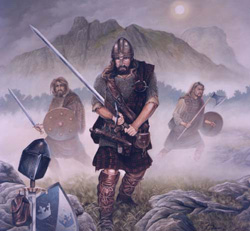
As the son of a nobleman, Wallace was sent to train with his uncle near Stirling. His uncle was a priest and from him Wallace learnt much about life as well as Latin. It was here that Wallace also learnt about freedom and liberty from the novels that he read. This lesson would stay with him for life.
When Alexander III died after a horseriding accident he left no successor to the Scottish throne. None of his own children had survived him at a time when many died young. He did have a granddaughter Margaret who was declared Queen by the Scottish lords but she died at the age of 8 on her way from Norway to Scotland.
A time of in fighting started where 13 claimants came forward to take the title of King of Scotland. Plotting went on within the Scottish and the English nobility and King Edward I (Edward Longshanks) believed that he should be King of Scotland.
At this time it was a hard life for commoners as bands of English, Welsh and Irish mercenaries made their way around the country, took what they wanted and generally terrorized the women.
It was in a skirmish with English troops that Wallace’s father was killed. Wallace sought revenge and tales of his rage and ferocity have gone down in history.
Because he was so tall and powerful, Wallace earned the respect of his fellow men and it is said that his good looks meant that he was looked up to as some kind of an idol.
“His visage was long, well-proportioned, and exquisitely beautiful; his eyes were bright and piercing, the hair of his head and beard auburn, and inclined to curl; that on his brows and eyelashes was of a lighter shade. His lips were round and full. His stature was lofty and majestic, rising head and shoulders above the tallest men in the country.” The Life of Sir William Wallace of Elderslie, Carrick.
There was general unrest in Scotland whilst Scottish noblemen and Longshanks debated the rights to the throne and Wallace and his band of around 30 followers attacked many English soldiers.
Longshanks conquered Scotland in 1297 and defiance against the British grew. As Wallace attacked British forces he became the enemy of the King and his band of followers multiplied.
After invading northern England Wallace was knighted and proclaimed guardian of the kingdom of Scotland by Scottish noblemen.
There are many varying tales of how Wallace spent his time after this and of how many attacks he made on the English. It is even said that he spent some time in France at some stage to gain support from the French King, Philip IV.
But what is sure is that on August 5th 1305 Wallace was betrayed by a Scottish knight and was arrested near Glasgow. Taken to London he was tried for the wartime murder of civilians and although he maintained that he had never sworn allegiance to Longshanks, was condemned as a traitor.
Wallace was executed in front of a large crowd in London on August 23rd 1305. The execution for the crime of treason was to be hung, drawn and quartered.
Wallace was dragged to the place of execution, hanged by the neck (but not until he was dead) and disemboweled whilst still alive. He then had to watch his own entrails or innards being burnt before he was finally decapitated and mercifully died.
His body was then quartered and pieces were sent around the country to act as a deterrent to any more potential treasonous people.
Wallace’s death was meant to have been the breaking of the Scottish spirit by Longshanks but it only served to backfire on him and the Scots were determined to be free.
Wallace was declared a martyr and Robert the Bruce of Scotland led the national rebellion that won independence for Scotland and was crowned King of Scotland in 1306.
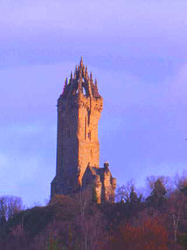
Wallace has gone down in the history books as perhaps the greatest leader that Scotland ever had. A monument stands on a hill near Stirling where the Scots and the British fought.
It serves as a reminder to everyone of the way that this remarkable man fought for the freedom of his country.
Join us soon for another Feature.