

Feature – The Wright Brothers
Born in Ohio (United States) in 1867 and 1871, respectively, Wilbur and Orville Wright were the sons of Milton, a traveling bishop, and Susan, a mechanically agile housewife who loved to teach her skills to her sons. (They also had a sister, Kate.) When Milton brought a rubber-band powered toy helicopter back from one of his trips, Wilbur and Orville constructed their own copies of the toy.
Although they were very close to eachother, Wilbur and Orville were very different boys. Wilbur was an extremely successful student and athlete. Orville was more mischievous and took an interest in the printing trade. So, while Wilbur was a bit of a school-nerd, Orville distinguished himself as the class clown.
Although Wilbur planned to attend college, when his mother took ill with tuberculosis and he was injured in a sporting accident, Wilbur put off college and stayed home to tend to his mother. Orville did not even finish high school, but dropped out midway through his senior year in order to start his own printing business.
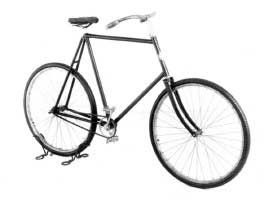
In 1890, Wilbur joined his brother’s business, serving as editor of a weekly neighborhood press, and the pair unsuccessfully attempted to market a small daily newspaper. However, they soon became attracted to the growing bicycle industry, and, by 1896, they were manufacturing their own bicycles through their successful new business, The Wright Cycle Company.
Although printing and bicycling (and eventually airplane engineering) appear to be disjointed pursuits, they were linked by a need for mechanical skills and creative design.
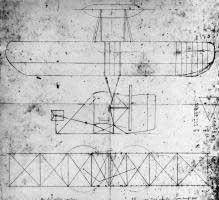
In 1896, stories of flying machines were filling the presses. None of the machines had any means for in-flight control, and Wilbur and Orville set about to find a means for bicycle-like balance. In 1899, Wilbur invented a system to twist the wings of a craft, causing it to turn right or left.
They began to use kites to test Wilbur’s new system, then gliders. Orville and Wilbur chose Kitty Hawk, North Carolina (in the United States) as their testing grounds, as the Atlantic winds helped to lift the gliders, and the beach sand softened the landings for their constantly crashing gliders.
Their early gliders were royal failures (or successful learning tools, to be optimistic), which did not lift easily, and were restrictively difficult to control.
In the winter of 1901-2, Wilbur and Orville constructed a wind tunnel and used it to perform experiments in wing shape until they devised a glider with better lift. They then concentrated on the problem of control. In 1902 they created the first fully controllable aircraft, using roll, pitch, and yaw controls, as are still used by planes today.
With the help of their bicycle mechanic, Charlie Taylor, the brothers designed a powerful, light-weight gasoline engine. They also built the first airplane propellor.
Using their wind-tunnel tested wings, their roll, pitch and yaw controls, their new engine, and their propeller, they built their airplane.
Unfortunately, they were in competition with Samuel P. Langly, the director of the Smithsonian Institution, who had built his own powered aircraft, which was also being tested in Kitty Hawk, NC. As the Wrights were delayed by propeller problems, Langly was able to test his aircraft twice in late 1903. Fortunately for the Wrights, both of Langly’s well-publicized trial flights were miserable failures.
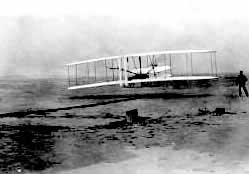
On December 17, 1903, as Wilbur stayed on the ground counting seconds, Orville got to take the first sustained, controlled flight in human history.
After the unsteady but successful flight, Wilbur and Orville set about to perfect their invention, establishing the first official flight-testing facilities at Huffman Prairie, Ohio. After two years of testing, they were flying figure-eights over the prairie, and remained in the air for over a half an hour at a time.
The Wrights immediately began to market their 1905 Wright Flyer as a war machine, contacting the US War Department, as well as the governments of England, France, Russia and Germany.
In 1907 the US Army Signal Corps asked for an aircraft, and in 1908 a French business syndicate purchased another. As requested by their buyers, the Wrights redesigned their plane with a passenger seat and a more powerful engine.
Orville and Wilbur split up to do flight demonstrations, until a propeller failure caused Orville to crash, breaking his leg, and killing his passenger. The flight demonstrations went on, to great acclaim, turning Orville and Wilbur into the century’s first superstars.
As their fame grew, so did their sales. The Wrights set up airplane factories and flight schools internationally. Unfortunately their flight demonstrations also created competition, as engineers were able to copy the Wrights’ working plane.
A bitter legal battle ensued as the Wrights attempted to gain patent control over the airplane. In the process of the conflict, Glenn Curtiss modified Langly’s failed aircraft to demonstrate that this model could have worked. Although the Wrights eventually won the legal suit, a huge resentment between the Smithsonian Institution (which owned Langly’s craft as well as employing Langly himself).
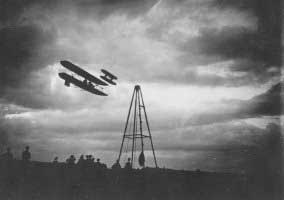
With their attention focuses on legal battles and product marketing through increasingly deadly air-shows, the Wrights were unable to concentrate on developing airplanes, and their planes were soon surpassed by competing machines.
In 1912, Wilbur contracted typhoid and died. Orville sold the Wright Company in 1916, and went back to inventing.
Orville tinkered with eclectic interests ranging from guided missile designs to lighter inventions, such as an automatic record changer, and children’s toys. He joined the board of the National Advisory Committee for Aeronautics (NACA, which later became NASA), and helped to oversee the Guggenheim Find for the Promotion of Aeronautics.
The rivalry between the Wrights and the Smithsonian Institution continued, as the Smithsonian exaggerated Langly’s contributions to aeronautics and undermined those of the Wrights.
In retaliation, Orville sent the 1903 airplane to the Science Museum of London, where it remained until the Smithsonian corrected the records in the 1940s.
Orville’s final project was to reconstruct the 1905 Wright Flyer for display in a park in Ohio. He did not see the placement ceremony, as he died of a heart attack in 1948, while fixing his doorbell.
Join us soon for another Feature.