

The life of African Americans up to and during the Civil War
Slavery and Freedom
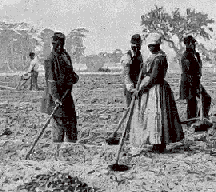
Arriving in American after being captured in their African homelands and transported via ship by slave traders, the original African Americans were then sold to the highest bidder, for whatever purpose the purchaser had in mind. Most were used as plantation labourers or domestic slaves. The treatment they received varied greatly depending on both their master’s temperament and their own. Newly captured slaves, unaccustomed to the bonds of slavery, regularly attempted to escape, but with no local knowledge of the land, language, or safe destinations, were often quickly caught, punished and returned to their owners.
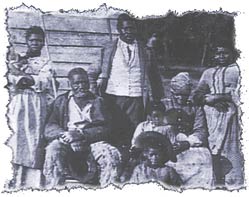
It was common for several generations of the same slave family to live and work on the same plantation, but as they were considered a commodity, family members could also be sold off to different places at their master’s whim. Life for the African American slaves was difficult. Not unlike a workhorse, they would be fed and given minimal shelter in return for working 16-18 hour days seven days a week. The young and strong were prized possessions, but the injured, weak, old or troublesome were dispensable.
Even with the abolition of slavery in 1864, change did not happen overnight. With freedom of the former slaves came new logistical problems such as finding willing workers for the jobs slaves had been doing, and jobs and housing for the thousands of freed slaves who no longer wanted to work for their old masters. A major obstacle to the reform was the attitudes of the masters and slaves and their descendants. Prejudices and bitterness run deep and it has taken generations for attitudes and racial prejudices to soften.
Escape from slavery and The Underground Railroad
African Americans fled slavery in the South for a variety of reasons. Brutal physical punishment, psychological abuse and endless hours of hard labour without compensation drove many slaves to risk their lives to escape plantation life. The death of a master usually meant that slaves would be sold as part of the estate, and family relationships would be broken. While some slaves headed north with relatives of friends, most travelled alone, supported by the kindness of other African Americans or abolitionist whites they might meet on the way. Only a small number of slaves travelled by the organized network of routes, “conductors” and “stations” that came to be known as the Underground Railroad.
African American men and women of all ages left the plantation and headed North for freedom. But most runaway slaves were young men who could withstand the hardships of fugitive life. To escape the deep South and make it North to New York, Massachusetts or Canada meant a journey of hundreds of miles, usually on foot. Escaped slaves faced a life of hardship, with little food, infrequent access to shelter or medical care, and the constant threat of local sheriffs, slave catchers or civilian lynch mobs.
Plantation owners whose slaves ran away often placed runway slave advertisements in local newspapers. Such ads often included a person’s physical description, likely location or destination, and information about temperament — at least as perceived by the plantation owner. While rewards varied, they could run as high as $1,000 — a not unreasonable price considering the lifetimes of free labour a Southern planter could hope to extract from a slave and his or her children.
Not all runaway slaves fled to the North. Some fugitives sought refuge in cities such as Atlanta, Charleston or Richmond, where they attempted to blend into existing African American populations — often with the help of other fugitives or free blacks. Others established freedmen’s encampments in rugged rural areas where they could remain hidden from slave catchers or local legal authorities. Such groups often supported themselves by stealing food and supplies from nearby plantations.
For slaves who lived in border states such as Maryland, Kentucky and Virginia, the journey to freedom could be short and less terrorizing. The long, unguarded borders represented an ideal opportunity for slaves in cities such as Baltimore. Slaves who lived with access to fresh and saltwater ports often stowed away or hired on as hands on Northbound vessels. Once they reached a free port, the fugitives jumped ship to freedom.
The passage of the second Fugitive Slave Act in 1850 made escape from bondage harder than ever. Under the provisions of the act, slaves who escaped to free states or federal territories could be forcibly returned to their masters. Anyone who aided a fugitive slave — and federal marshals who failed to enforce the law — faced severe punishment. Slaves taken to court for breaking the fugitive slave law could not testify on their own behalf, and were not allowed the right to a jury trial.
In the North, Hicksite Quakers and other abolitionists provided some of the most organized support for the Underground Railroad. Particularly in the wake of the Fugitive Slave Act, a night’s lodging, a place to hide from slave catchers, a meal, and covert transportation by wagon, boat or horseback proved welcome to slaves fleeing the South.
Of the thousands of slaves who fled the plantations each year, most never made it to freedom. Many returned to the plantation after a few days or weeks away, tired, hungry and unable to survive as wanted fugitives. Others were carried back in chains after their capture by lawmen or professional slave catchers. The punishments these slaves faced upon their return varied from verbal abuse to beatings, sale to another master, and even death.
A law to gradually phase out slavery in Upper Canada, which is now Ontario, was passed in 1791. The British Empire, of which Canada was a part, abolished slavery throughout its territories in 1833. Underground Railroad activity flourished in cities such as Rochester and Buffalo, which were near the borders of Upper Canada. For those who endured the long journey and all its hardships, Canada was the Promised Land.
In the North
Whether born slave or free, African Americans in the North found themselves at the centre of the conflict over slavery. Here are three African Americans who became well-known for their involvement in the most important issue of their day.
Maria Stewart
Maria W. Stewart was America’s first female African American political writer. Producing most of her work in the early 1830s, she preceded Sojourner Truth, Frances Harper, and even Frederick Douglass, who didn’t launch his career until 1841. She was a pioneer of the abolition movement as well as of women’s rights, the rights of African American women in particular. In 1832, sixteen years ahead of the women’s rights convention at Seneca Falls, Stewart publicly mounted a platform in Boston to give a political speech, the first time an American-born woman, African American or white, had done so. At that event she spoke out against the colonization movement, which sought to repatriate African Americans to Africa. In other speeches and essays, she called on African American women to develop their intellectual faculties and to destroy the racial and gender restrictions that bound them. An orphan by the age of 5, she spent her early years as a household servant and experienced the hard toil many other NorthernAfrican Americans endured, in a status that Stewart considered to be only “nominally free.” And yet she was heavily influenced by the dynamic African American community that surrounded her in Boston and the rapidly growing anti-slavery movement. During the Civil War, she was matron of a freedmen’s hospital in Washington, D.C., and stayed there to teach and minister to the African American community until her death
Shadrach Minkins
Shadrach Minkins was the first fugitive slave to be recaptured in New England under the Fugitive Slave Law. A stricter enforcement of the law had been a provision of the Compromise of 1850 as a concession to Southern slaveholders. Boston possessed a small, free black population and was the nation’s center of abolitionist activity, so it was naturally a prime target for slave catchers. Minkins was born a slave in Norfolk, Virginia, and passed through several owners before coming to John DeBree, the man from whom Minkins would eventually escape. Minkins survived the perilous journey North to freedom and made it to Boston, where he was able to find work as a waiter in 1850. It was not long before DeBree presented proof of ownership to the Boston federal court, prompting federal officers to arrest Minkins while he was serving breakfast at the Cornhill Coffee House. He was taken to the courthouse, but at his trial, outraged black residents of the city, themselves threatened by the new Fugitive Slave Law, stormed into the courtroom and rescued him. The entire affair, from the arrest to the rescue, occurred over a period of only three hours. This time Minkins made the journey north to Quebec Province, where Canadian law guaranteed his freedom. There he married and raised a family, in a community largely made up of other fugitive slaves who had successfully sought freedom and a new life.
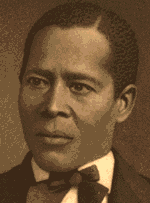
William Still
William Still was instrumental in Underground Railroad activity in Philadelphia. He was born free in 1821, the youngest of 18 children. At the age of 23, he arrived in Philadelphia and joined the Pennsylvania Society for Promoting the abolition of Slavery in 1847. While a member of the Society, Still would frequently board runaway slaves in his home until they were able to secure safe passage to Canada. By the time of the formation of the new Philadelphia Vigilance Committee, an agency of the Underground Railroad, Still was a prominent member of the African American community and was named its chairman. Among his duties were raising financial aid for the fugitives who came to the committee for help. This included paying for their room and board in free African Americans’ homes, financing any medical aid that was needed, and purchasing railroad fares to Canada. But Still took greatest interest in recording the experiences of the 800-odd fugitives that his committee aided. Still documented details about the daily lives of the fugitives, including their time in slavery and their time in flight. In 1872, Still published this information in The Underground Rail Road, which circulated widely and went through three editions.
Join us soon for another Life Issues.