

Anne Frank

I don’t think that anyone could read ‘‘The Diary of Anne Frank’ without coming to dread the ending. This is because everybody knows in advance what will happen. Sure enough, below the end of her entry for 1 August 1944, are the words ‘Anne’s diary ends here.’ One can only imagine the terror and panic that Anne, and the other seven inhabitants of the Secret Annex, must have felt when they were discovered by the Nazis on the morning of 4 August 1944.
But the cruellest aspect of their capture was that they were so close to surviving the war. It would end in less than a year. The Allied invasion of Europe, which Anne and the other members of the Annex had been hoping for for so long, had happened two months before. When writing of the D-Day invasion in June, Anne said that she hoped to be back at school by October, and her second to last diary entry (21 July 1944) began ‘‘I’m finally getting optimistic.’
In all, Anne and the others were in hiding for 25 months. Anne had received the diary as a present for her 13th birthday on 12 June 1942, and her early entries were about every-day life for Jews in occupied Holland. But by early July, her elder sister Margot had received a summons to a concentration camp, prompting the family to go into hiding. Anne’s father Otto, suspecting that it may be necessary, had prepared a hiding place behind his warehouse at 263 Prinsengracht, Amsterdam.
Joining the family in hiding were Auguste and Hermann van Pels, and their son Peter; and later the elderly dentist Fritz Pfeffer. They got supplies and news from some of Otto’s non-Jewish employees, particularly Miep Gies. In spite of this generosity, the eight inhabitants had to deal with cramped living conditions, constant confinement, poor food, and the fear of discovery for more than two years. Therefore it is not surprising that they frequently quarrelled. Anne, in particular, fought with her unsympathetic mother, Pfeffer (called ‘Dussell’ in the diary), and Mrs van Pels (called ‘van Daan’ in the diary).
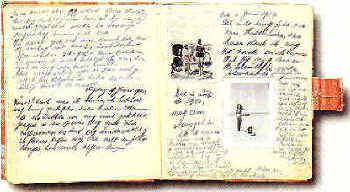
The diary also records the daily routine in the annex, which was based on trying to avoid discovery. The inhabitants whiled away some of the time by listening to radio reports – Anne’s diary comments on events such as deportations and executions, and she also heard about the existence of gas chambers via the BBC.
Owing to her circumstances and events in the war, she suffered from serious depression, leading her to ponder moral questions and the state of humanity. But her writing, ‘the best thing I have’, was ever a source of comfort to her.
Later, as Anne matures, the diary reflects her personal struggle to develop her true character, which she struggled to show, instead hiding behind a flippant, boisterous exterior, which often brought her into conflict with the others.
Several times the annex was dangerously close to discovery, as the result of break-ins in the warehouse. But ultimately it was an anonymous tip-off that caused the Nazis to discover the annex. All eight inhabitants were transported to Westerbork Concentration Camp, and then to the dreaded Auschwitz, where they were split up. Anne and Margot ended up in Bergen-Belsen, and both died in the typhus epidemic which swept the camp because of the appalling living conditions.
Anne died just weeks before the British liberated the camp, and of the eight, only Otto survived. He returned to Amsterdam in June 1945, to discover that Miep Gies had rescued Anne’s diary after the Nazis had looted the Annex in search of valuables. The diary was published in 1947, and has since sold 25 million copies – despite what Anne said, in an early entry, that ‘no one will be interested in the unbosomings of a thirteen-year old girl.’
With the profits that came from sales of the diary, Otto set up a charitable trust to pay the medical expenses of Christians who had helped Jews during the War. He remarried and moved to Switzerland in 1953, where he lived until his death in 1980, aged 91.
Anne’s diary has been published in fifty languages, and film versions were made in 1959 and 1996. The original diary is now in the War Documentation Centre in Amsterdam, and organizations dedicated to spreading the message of the diary have been set up in the USA, England, Switzerland and Germany.
Anne’s death was a tragic loss to the world, but her wish to become a famous writer and be remembered after her death has come true.
Join us soon for another Life Issues.