

Life Issues – Leonardo da Vinci
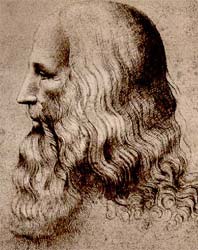
Leonardo da Vinci has recently become a hot news item, as films like Mona Lisa Smile and novels like The Da Vinci Code bring his work back into the spotlight. Who is this man who remains in the modern vocabulary of famous persons, nearly 500 years after his death?
Leonardo da Vinci
On April 15, 1452, Anchiano, Italy became the birthplace of one of history’s finest creators.
Leonardo was not legitimate. The son of the notary public, Ser Piero, and a farmer’s daughter, Lionardo (as he was originally christened), was raised by his father (and his father’s series of wives) from the age of 5.
Leonardo was schooled in Vinci (for those keeping track, ‘da Vinci’ means ‘from Vinci’), were he learned reading, writing, arithmetic, Latin, and geometry, all skills he would employ at great length in his later career(s).
In 1466, at the ripe old age of 14, Leonardo moved from Vinci to Florence, where he began an apprenticeship in the workshop of Andrea del Verrocchio, who was the most talented artist in Florence, with a polymaths collection of skills, including sculpting, painting, goldsmithery, bronze casting, and more. While working in Verrocchio’s studio, Leonardo was peer o many up and coming artists, such as Perugino, and Botticelli.
Leonardo was accepted as an apprentice based upon his fascinating drawings and sketches. When he arrived, he did not know how to paint. He began his studies with the mixing of colours, and then he began to paint simple sections in other artist’s paintings. There are no known works by Leonardo from 1466-1472, but in this period, he taught himself the art of oil painting.
In June, 1472, Leonardo was listed in the red book of painters from Florence, thus ending his apprenticeship with Verrocchio. However, he did not choose to leave Verrocchio’s studio at this time.
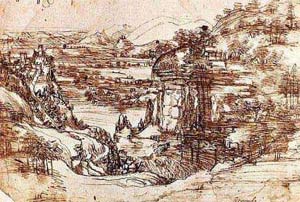
The first known, dated work by Leonardo is a pen-and-ink drawing of the Arno Valley, dated 5 August, 1473.
Scandal in Artsville
In Leonardo’s time, it was common practise to place anonymous accusations in a wooden box (called a ‘tamburo’ for those learning old Italian), which stood in front of the Palazzo Vecchio.
On 8, April, 1476, an anonymous accusation was placed against 4 people, including Leonardo, who was accused of having a saucy love affair with Jacopo Saltarelli, a male model. The subsequent impeachment procedures ended in an acquittal of all charges against all participants.
This event has been turned into fodder for the great debate about Leonardo’s sexual orientation. (But, really, at the end of the day….who cares? His most important legacy would never have been his children. His art is legacy enough.)
Anecdote complete. Back to painting.
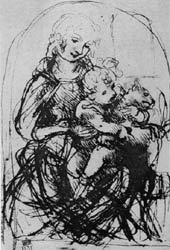
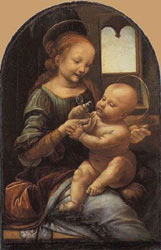
Unfortunately, many of Leonardo’s paintings were left unfinished, or even disassembled. Often, Leonardo’s sketches are much more interesting that the paintings themselves, and give an indication of the direction in which he planned to take the paintings. In a world full of murky browned Rennaissance paintings , Leonardo’s fascinating personal style show through much more clearly in his sketches than in his paintings.
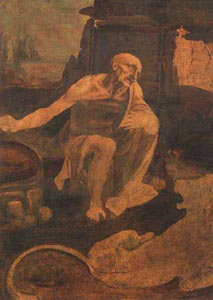
In the case of the 1481(ish) painting of St. Jermoe, a Vatican art collector bought the unfinished painting, despite the fact that the head of the figure had been cut out! Later, the collector was miraculously able to track down St. Jermoe’s missing head, which was hiding out in a shoemaker’s workshop. St. Jermoe’s head was stitched back onto his body, and he now sits in tact in the Vatican.
The Mad Scientist
In addition to his skill as an artist, Leonardo was an imaginative inventor. You may recall a discussion of his designs of flying contraptions, including a creation closely resembling the modern helicopter, as discussed in previous articles on airplane flight and the Wright brothers.
It is also likely that Leonardo invented the bicycle. Baron Drais von Sonnerbronn, a curator for the museum in which Leonardo’s Codex (a book of sketches, manuscripts, etc) was non-publicly stored, is credited with the invention of the bicycle in 1897. However, a recent discovery was made—inside the Codex, a page was folded in half and glued to itself. When the page was carefully pulled open, it revealed a brown charcoal sketch of a bicycle, almost certainly made by one of Leonardo’s students, as a copy of one of his sketches. Further investigation reveals sketches in Leonardo’s hand of a bicycle chain matching the chain in the student drawing. But no original sketch of the bicycle could be found.
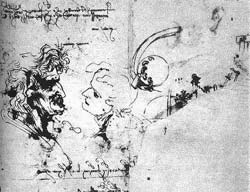
Is it possible that a museum curator could be so scrupulous as to steal a historic sketch by one of the world’s most famous artists, and take credit for the idea? Unfortunately, all evidence points to yes.
The Last Chapter
King Francis I invited Leonardo to live out the rest of his life at the French court in Amboise. Leonardo showed up in 1516, carrying the famous Mona Lisa in his bags. However, he did not paint in France, he made hydrological studies.
Leonardo died on 2, May 1519, in Amboise, at the age of 67. He was laid to uneasy rest in the heart of the king castle in San Fiorentino. After the destruction of the church and parts of the castle, Leonardo’s remains were transferred to the Chapel of St. Hubert.
For more information and more of a look at Leonardo da Vinci’s artwork take a look at the Britsh Library Website
Join us soon for another Life Issues.