

The Egyptian Wife
The Egyptian Wife
For all the importance placed on religion in ancient Egyptian life, there was one place it had no role at all: the Egyptian marriage. There wasn’t even a civil ceremony. Rather, marriage simply took place when two young people decided to move in together (usually the bride would move in with her husband) and start a common household. But that doesn’t mean that marriage was not taken seriously. From the paintings found, letters that were left from grieved widowers to their deceased mates, and from statues from all periods of ancient Egyptian history, marriage and a close family played an integral role in ancient Egypt.
Love and Marriage
A bride would be young, about 14 or 15 years old. Her husband could be anywhere from 17 to 20—or older if he was divorced or a widower. The ancient Egyptians were encouraged to marry young, considering that the life span at this time was relatively short. Many marriages were arranged with parental consent needed. But the abundance of love poetry between young people signifies that many couples did fall in love and choose each other as mates. Women played a large role in arranging a marriage. A suitor sometimes used a female go-between to approach the girl’s mother—not her father.
Interestingly, one of the most affectionate titles you could call your love was “brother” or “sister” in ancient Egypt. This had nothing to do with sibling relations, but led many archaeologists and scholars to wrongly assume that most ancient Egyptians married their siblings. Actually, this usually occurred only among royalty—and was not a common occurrence.
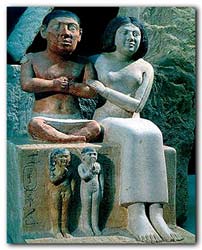
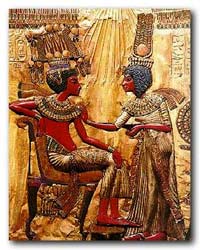
Museums are filled with statues and paintings showing husbands and wives with their arms around each other’s waists, holding hands or offering each other flowers or food. Love and affection was indeed a part of the Egyptian marriage, and our Egyptian bride could expect to be loved and respected by her husband.
The Marriage Settlement
Most marriages had a contract drawn up between the parties. The poorer classes probably did not do this because they probably had few possessions to consider and also the cost of a scribe would have been prohibitive.
Marriage settlements were drawn up between a woman’s father and her prospective husband, although many times the woman herself was part of the contract. The sole purpose of the contract was to establish the rights of both parties to maintenance and possessions during the marriage and after divorce if it should occur—very similar to today’s prenuptial agreements. What is really fascinating is the equality women held with men in their rights to own, manage and receive property.
If the marriage ended in divorce, the rights of the wife were equally protected. Generally, she was entitled to support from her husband, especially if she was rejected by him through no fault of her own. The amount might equal one third of the settlement or even more. If the bride ended up committing adultery (which was extremely frowned upon for both men and women), she still had certain rights to maintenance from her former husband. Monogamy, except for some of the higher classes and royalty, seemed to be the rule for most ancient Egyptian couples.
Here’s a standard marriage contract that had been found among the numerous records left by the ancient Egyptians. It contained:
- The date (the year of the reign of the ruling monarch)
- The contractors (future husband and wife)
- The names of both sets of parents
- Husband’s profession (wife’s rarely mentioned)
- The scribe who drew up the contract
- The names of the witnesses
Then the details of the settlement followed. Here is the beginning of a marriage contract from 219 BC:
“The Blemmyann, born in Egypt, son of Horpais,
whose mother is Wenis, has said to the woman
Tais, daughter of the Khahor, whose mother is
Tairerdjeret: I have made you a married woman.
As your woman’s portion, I give you two pieces of
silver…If I dismiss you as wife and dislike you and
prefer another woman to you as wife, I will give you
two pieces of silver in addition to the two pieces of
silver mentioned above… and I will give you one third
of each and everything that will accrue to you and me.”
The finished document was given to a third party for safekeeping or kept among the records of the local temple.
One of the expectations of the ancient Egyptian marriage was the bringing forth of children. Sometimes there would be a trial marriage for a year to see if pregnancy would occur. This was all stipulated in the marriage contract.
In some parts of ancient Egyptian society, men were permitted to have concubines. Naturally, it worked out better for the husband if his bride approved. But concubines did not have the same protective status as wives. And adultery, even in households where there were concubines, was strongly discouraged.
The Wedding Day
The day of the marriage was really quite simple. The bride merely moved her belongings into the home of her husband. He might be living alone or with his parents.
So what did the bride wear? She probably wore a long dress or tunic made of linen, which may have been covered from head to toe with bead-net. If she owned any gold, silver or lapis, she probably adorned herself with those, too. Unless, of course, she just dressed “down” for moving day.
Even though there was no official ceremony, knowing how much the ancient Egyptians loved music, dance and food, there were bound to be family celebrations in honor of the uniting couple.
Divorce Ancient Egyptian Style
What if it didn’t work out? Divorce was as easily initiated as marriage. Divorce could be brought about by either party; it was a private matter and the government took no interest in it.
The most common reasons for a husband to divorce his wife included the inability to bear children, especially a son; the desire to marry someone else—or that she simply stopped pleasing him. A woman could divorce her husband for mental or physical cruelty or adultery. In some cases, if the woman chose to divorce, she forfeited her right to communal property.
Once divorced, both men and women could remarry as soon as they wished. And from the archives we have found, it seems that they readily did. It’s also apparent that our ancient bride, with the ease of marriage and divorce and the financial protection she generally received, had a better time of it than some brides in modern times.
A day in the life of a nobleman’s wife:
The wife of an Egyptian nobleman would wake up in a bed covered in fine linen sheets. She would see the cabinet where her clothes were kept, her cosmetic box, and a lamp for lighting the room in the evening.
She would get up, and while her husband is being shaved and dressed by his servants, she would wash and dress with the help of another servant. Her dress would be of fine linen and her jewellery made of glass. She would apply kohl to her eyelids and go downstairs.
The nobleman and his wife would sit on cushions at a low table and eat a simple meal of bread and fruit served to them by their servants.
While the nobleman went our to meet with the overseer of his properties, his wife would supervise the preparations for the banquet they were hosting that evening. Their children would be dressed and fed and brought to her by a servant.
In the early afternoon the nobleman’s wife would go out into the garden to escape the heat of the day. She would enjoy the shade of the trees while she watched her children play with their toys.
Later in the afternoon the nobleman’s wife would begin preparing for the evening banquet. Her servant would brush and curl her favourite wig. She would take out her most beautiful clothing and her jewellery made of gold and semi-precious stones.
The nobleman would returned to the house and get ready for the banquet. Then he and his wife begin greeting their guests as they arrived.
The guests would be offered cones of perfumed wax and lotus flowers by servant girls. They would eat the finest meats, breads, cakes, wine, figs and dates. They were entertained by musicians and dancing girls.
At the end of the evening, they said goodnight to their guests and went to bed.
A day in the life of a farmer’s wife:
The typical ancient Egyptian farmer’s wife would wake up in a bed covered in a coarse linen sheet that she had woven herself. In her bedroom, she would see the shelf on which her clothes were kept. She will have washed and dressed in the early morning light and have woken the children in the next room, and begun her daily chores by the time her husband has woken up.
She would be wearing a dress made of coarse linen. Around her neck she would wear an amulet of the goddess Tawaret on a piece of papyrus string.
She would prepare a small meal of bread and fruit, which she would eat with her husband and children. It would be served on reed mats while the family sat on a bench.
After completing the morning meal, the farmers wife would light the cooking fire and begin grinding the wheat to make bread. She would spend the day grinding wheat and baking bread, and in the afternoon, would walk with her children to the river to collect water.
In the evening she would prepare a small dinner of bread, meat and beer for her family.
As it grew dark outside, the farmer lit the small oil lamp. The farmer and his wife put their children to bed, blew out the lamp and went to sleep.
Resources
Extracts taken from The Egyptian Bride by Irene Springer
Join us soon for another Life Issues.