

Life Issues – Eskimos
Family Structure.
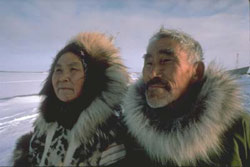
Eskimos lived in groups of several families, which might be as large as several hundred people. A ‘family’ was a rather extensive group consisting of a husband and wife, their unmarried children, their married sons and their wives and children, etc.
Eskimo children were considered to be gifts or treasures. As such, they were rarely punished. All the same, given the harsh living conditions and constant demands of survival in a nearly impossible environment, these children were definitely not spoiled.
Duties in the Eskimo family were divided into pretty traditional gender roles. Men were expected to hunt food, drive the dogsled, row the boat, and build the shelters. Women had the duties of making warm, windproof clothing, looking after the children, cooking, and sometimes helping the men with their duties.
Although the gender based division of duties has all of the makings of a sexist, patriarchical society, this was not the case. Women’s duties were not considered to be of lesser importance than those duties given to men; nor were women considered to be the second-rate sex. Rather, despite the differences in the way men and women spent their days, men and women were considered to be quite equal.
Law and Order: S-K-mo
There were no laws in Eskimo society, only a few basic rules of conduct. These rules were simple: everyone should keep themselves useful and work to help the group survive, and everyone should act peacefully. Those who were lazy or aggressive were generally despised but not punished.
Any disagreements might be settled by an organized fight, or through a contest of insult-hurling (in which the first person to become hurt or upset would have lost the contest and the dispute).
Those who committed a murder or serious crime might be executed, but that decision was only made by the older men in the group.
Spirituality
Eskimos believed that spirits controlled natural elements, such as the weather, the waters, and the moon. Each community had ‘angatkuq’ (a shaman) with the power to communicate with the spirits. They tried to compel the spirits to help them out by healing the sick, increasing the number of animals in the area, bringing good weather.
Probably the most important of the spirits was Sedna, the goddess of the sea. Sedna was believed to live at the bottom of the ocean and rule over seals, whales, and other sea creatures. If the Eskimos did something to displease Sedna, she might drive away these animals upon whom the Eskimos depended.
Though the Eskimos had no qualms about hunting animals to fulfill human necessities, they did believe that people and animals alike had souls, and that all of these souls went to another world after death.
Special practices were enforced to keep these souls and spirits at bay, so that they would not inflict punishments such as illness on the living. The body of a dead Eskimo would be wrapped in animal skins and laid out in the tundra, protected within a circle of stones, with tools and other items placed near the body for the soul to use in the next life.
This Modern Life
Of course, as with many living tribal cultures, Modern Eskimos have strayed from their past practices. Rifle hunting and climactic changes have reduced the numbers of animals that were once so central to their lives.
Most Eskimos today live in permanent towns or settlements. They wear modern clothing, inhabit modern houses, even rely on modern capitalism, eating food purchased in the store, rather than food they acquired for themselves directly.
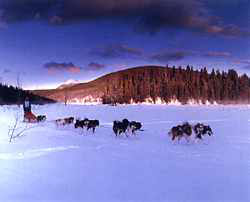
Where they once used kayaks and dogsleds to move around in water and on land, they now use motorboats and snowmobiles. Many have renounced Eskimo beliefs in favour of Christianity.
Though there are nearly 120,000 Eskimos living in various areas today, it is difficult to claim that Eskimo culture is alive and well.
What remains is a strange shade of grey, an amalgamation of tribal identity and western culture that is proving even more difficult to maintain than to explain.
Join us soon for another Life Issues.