

Life Issues – Florence Nightingale (19th Century)
In 1820, English honeymooners William Edward and Frances Nightingale had a baby girl in Florence, Italy, and decided to name her after the city of her birth. During her long and fruitful life, Florence Nightingale was to become nursing’s most legendary figure.
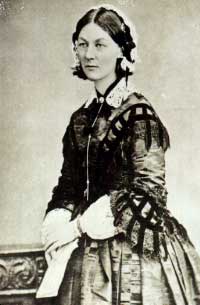
William and Frances were highly-educated people of high social standing, and after their return to England in 1821 William began the education of his daughters himself. Florence’s education included learning Latin, Italian, French, Greek and German.
At the age of 17, she claimed to have heard the voice of God commanding her to do his ‘work’ – unfortunately she had no idea what this could be! However, this event probably influenced her growing interest in the social issues of the day.
In early Victorian times, there was a vast divide between the living standards of the rich and the poor, and the poor often suffered shockingly bad health. Florence wanted to help the sick, but in the nineteenth century nursing was considered a disreputable profession, especially for a well- educated young woman of high social standing. But in 1851 Florence completed a three month training course at the medical school in Kaisersworth, Germany.
In 1854 the Crimean War broke out, and it quickly became clear that disease posed a bigger threat to the British soldiers than the actual fighting. This situation was made even worse by the appalling conditions in the British military hospital, which was crowded and unsanitary, and had a death rate of 40 percent. Sidney Herbert, the British Minister of War, appointed Florence to oversee nursing in the military hospital.
In Crimea, Florence was faced with opposition from the military doctors, who saw the presence of female nurses as a possible distraction for the soldiers. In spite of this, Florence was able to introduce a special diet, ensure that the patients were fed three times a day, and improve sanitation. As a result of her efforts, death rates in the hospital plummeted to two percent by the time the war ended in 1856.
After her return to England Florence began work on her greatest achievement – that of making nursing a respected profession. In 1860 she established England’s first ever training school for nurses at St Thomas Hospital in London.
Florence’s scrutiny of the trainees ensured that they did not become debauched and disreputable as nurses had been before! Instead, the trainees learned Florence’s principles of nursing – close observation of patients and sensitivity to their needs.
Florence was also influential in introducing standards for sanitation and ventilation in hospital wards. In 1883 she received the Royal Red Cross from Queen Victoria, and in 1907 she became the first woman to receive the British Order of Merit. By the time of her death in 1910, she had published almost 200 books and pamphlets on nursing. Nearly a hundred years later, much of her writing is still influential in the medical profession.
Join us soon for another Life Issues.