

Life Issues -The Life of a Gladiator
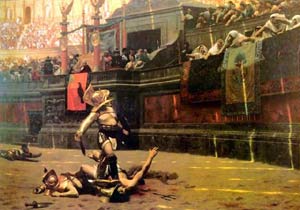
In general a Gladiator was a condemned criminal, a prisoner of war or a slave bought for the purpose of being trained as a gladiator. Professional gladiators were often free men who volunteered to participate in the events. These free men although they were low on the social scale would often become popular amongst the crowds and find popularity and patronage with wealthy Roman citizens over their criminal counterparts.
The masters or owners of the gladiators were called lanista. Gladiators were required to do what their lanista ordered and therefore they were revered for their loyalty, discipline and courage. As a gladiator a man gained immediate status even though as a gladiator he was forced to act as a slave and to endure flogging, branding or death by the sword.
Typically a gladiator was sent to a gladiator school and depending on whether he was a criminal or not he was either trained to use weapons or taught to be a gladiator who would enter the gladiatorial arena weaponless. A criminal would typically use a weapon and could even earn their freedom if they survived three to five years of combat. A gladiator was only required to fight two to three times a year but few survived the three to five years.
Gladiators trained like modern athletes do today. They received three square meals a day to keep them healthy and strong and they got medical attention if they needed it. They trained for hours each day and learnt how to use various weapons including the war chain, net, trident, dagger and lasso.
Myrmillo – swordfish
had a helmet with a fish crest, oblong shield and sword and usually fought a retiarius.
Retiarius – fisher with a net
was armed with a net and trident or dagger.
Samnis – man from Samnium, Samnite
had a short sword (gladius), visored helmet and oblong shield.
Thrax – man from Thrakia, Thracian
was armed with a curved dagger (scimitar) and round shield.
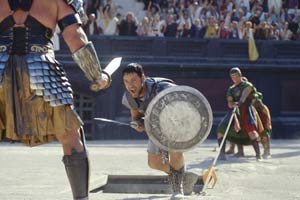
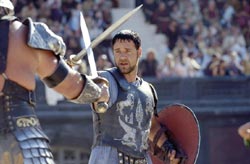
Each gladiator could choose how they wished to fight – they could choose their armour and their weapon of choice. They would dress up for the crowds and wear helmets, specially shaped shields and some would only wear a loin cloth.
Gladiators were paid each time they fought and if they survived their three to five years they were freed. The most famous gladatorial arena was the Colosseum built by the flavians in Rome but there were many arenas around the world at the time.
Gladiatorial fights were often two gladiators pitted against each other in one on one combat. Special sponsors of the games or vip guests could request other combinations like several gladiators all fighting each other at once.
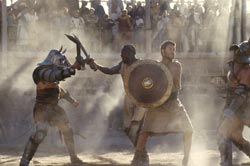
Contrary to what is seen in most movies, it was less likely that gladiatorial combat would result in death. Gladiators were expensive to maintain, train and replace. Keeping the gladiators alive, producing money and keeping the most popular crowd pleasers was far more practical. But there were definitely deaths. When an opponent was overpowered the victor would turn to the crowd for a reaction. The defeated gladiator would sometimes hold up a finger on his left hand asking to be spared. But the crowd would yell whether or not they wanted his life to be spared or whether the victor should finish him off. The official decision was usually left to the Emperor if he was present.
If the decision was death, there was a ritual to be performed which would bring honour in death to the loser. With one knee on the ground the loser would grasp the leg of the victor, who, while holding the helmet or head of his opponent would plunge his sword killing the man instantly.
The only task left now was to remove the dead body. This in itself was also a ritual. An attendant impersonating Pluto the god of the dead would strike the body with a mallet – it is not known exactly why. Another attendant dressed as Mercury, escorter of souls to the underworld, used his wand, which was in reality a hot iron to poke the body to see whether the gladiator was really dead or not. There was no escape by pretending to be dead.
The winners of the battles would receive a palm branch and a sum of money and for especially outstanding performances a laurel crown was awarded. The victor would run around the perimeter of the arena waving the palm. The ultimate prize was permanent discharge from the obligation to fight in the arena, most certainly in recognition of an outstanding career than from just one performance. As a symbol of this award the gladiator would be given a wooden sword, perhaps to suggest that he no longer had to fight with real weapons or at the risk of his life.
Join us soon for another Life Issues.