

Life issues: Gone Fishing
Leading a Balanced Life
Life seems to be getting busier and busier these days. We often find ourselves putting most of our time into one activity and neglecting others that we know are just as important and satisfying.
Sometimes it can seem that there are just not enough hours in a day.
Maintaining a balance between work (or school) and other activities is vital to our well being.
Cleaver Jackson
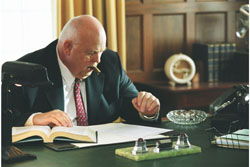
Cleaver Jackson in ‘Gone Fishing’ is a workaholic. He is bitter over the deaths of his wife and son and so his work has became all consuming for him. He is a successful businessman but is grumpy, overworked and very unhealthy. The doctor, at the start of the episode, gives Cleaver a word of advice –
“Work is no compensation for grief.”
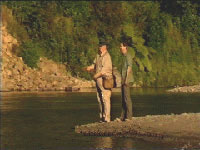
A chance accident involving Jess opens Cleaver’s eyes to what is actually important for him. He realises the lack of balance in his lifestyle. Through Jess’ help, Cleaver finds that the greatest pleasures in life can be gained from the smallest of things – in this case fishing.
As a result of Cleaver’s new found love of fishing and companionship with Jess, Cleaver develops a positive new outlook on his life and his health improves dramatically.
Others such as Perdita and Harvey are staggered to see Cleaver actually relaxing on evenings and weekends. They are used to him being at the office. Cleaver discovers that “freeing your mind, giving it a chance to wander – these are vital things.”
Balance
Cleaver’s new found clarity in thought and general well being occurred as a result of some relatively minor changes.
The benefits that fishing gave Cleaver included mild exercise, fresh air, and companionship – all things that go a long way to a healthy balance.
You will find that all parts of your life, including work efficiency, improve if you can work towards achieving this balance.
Some things that should be included in a balanced life
1. Exercise
Being fit helps you enjoy life. It gives you a positive outlook and helps reduce illness.
2. Leisure
Always have a hobby. It makes you a more interesting person.
There is a common, sad story of the man who died shortly after retirement because he felt he had no purpose in life. Have some life long hobbies that you always can go to for pleasure. Like Cleaver, take pleasure in the small things.
3. Rest
Most people need 7-8 hours a day
4. Work
Gives you a purpose and satisfaction
5. Quiet time to yourself
Find 20 minutes a day where you can do something quietly, for example, read or just think. Fishing was Cleaver’s ‘meditation.’ Everyone needs this time
6. Companionship
Spend some time talking to the people that you get on with. Laugh and talk about things away from other distractions– it doesn’t have to be heavy stuff
7. Diet
Eat healthily- it can prevent disease and illness
8. Water
8-10 glasses a day makes a huge difference to health and well being.
9. Taking in the fresh air
Good for your brain, good for your body
10. A positive attitude
Vital and often helped by the previous 9 factors
Juggling commitments
It can be really tricky but, like Cleaver proved, it is relatively easy to take some steps to improve lifestyle balance.
Here is a proven method for pro-actively improving your quality of life. It may seem like a bit of work to start with but the benefits that you gain as a result are definitely worth the effort.

Work, rest and play – how much for each?
Step One
If there are 24 hours a day and 168 hours in a week how many would you expect to spend working, playing and resting?
The old adage of 8 hours a day for work, 8 hours for rest, and 8 for doing everything else might be a good place to start. Work commitments may be more than 8 hours a day but remember you are juggling your week over 7 days.
Keep a track of how much time you spend on each of the above over a week. This could take the form of a timetable. In order to properly analyse the results; you should break down rest, work and play into more specific activities.
It would be a good idea to estimate your time division first and then compare it with your findings. The actual results may be quite different from your estimation!
Step Two
- Analyse your timetable.
- Which of the results were the same/ different to what you expected?
- What activities do you want to spend more time doing?
- What activities do you want to spend less time doing?
- Are you wasting any time that could be used in a more beneficial way (e.g. too much TV)? Note: relaxation time is not wasted time
- Draw up an ideal timetable. Consider all factors and make it realistic. Try keeping to it for a week.At the week’s conclusion review it.
Were changes beneficial. Do you feel better for it?
Useful in the future
Prioritising time now will be something that will come in very handy as you get older and people make more demands on your time. By using the tips raised in this article, you can be pro-active and organise other things around your time. In this way you are more in control than simply reacting and letting all of life’s surprises stress you out!