

Life Issues – Harry Houdini
Many daredevils have tried their luck at tightrope walking over the Niagara River, plunging over the Falls in a barrel or swimming in the rapids.
Perhaps the most famous person of all to have risked his life and lived to tell the tale at Niagara Falls is Harry Houdini.
Born in Hungary in 1874, Ehrich Weisz moved to the USA with his family in 1878.
The third of five children, Ehrich was aware that his family were not rich. His father was a religious teacher and scholar and secured work as a rabbi. The family had to move around a lot as times were tough for most immigrants to America and Ehrich started work at an early age to help his family.
He started to sell newspapers and polish shoes at the age of 8 years old. But it was when he was taken to see a show performed by a travelling magician Dr.Lynn that Ehrich became interested in magic and performance.
In 1883 Ehrich appeared before his first audience. He performed on the trapeze and as a contortionist and his title was Ehrich, The Prince of the Air.
Times were still tough for the family and when Ehrich was 12 years old he moved away for a year to try to make money with travelling circuses. At this stage he was dabbling with magic and had a new name to grab the audience’s attention – Eric the Great.
Ehrich travelled for a year and then met up with his family again. They had moved to a new home in New York City and Ehrich worked several jobs at once to bring money into the household.
Working as a photographer, a messenger boy, a cutter in a necktie factory, an electrical driller and an apprentice to a locksmith, Ehrich was no doubt a tireless young man. He still had time to get into mischief and one of the first locks that he learnt to open was on his mother’s cupboard. He stole an apple pie from it!
Ehrich’s father died in 1892 and Ehrich was more aware than ever that he had to keep bringing money into the household. Perhaps as a result of his father’s death Ehrich became concerned about fitness and he was constantly finding ways to stay in shape. He was an accomplished swimmer and even won swimming awards.
Ehrich still found time to read and it was when he found the autobiography of a French magician, Robert Houdin that Ehrich decided on his path in life. He wanted to be just like his new hero and went so far as to change his name to Houdini.
Houdini performed 20 shows a day and earned a grand sum of $20 per week, which went to wards his family. His brother became interested in performance and a double act was established. Houdini and his brother Theo performed many spectacular acts of escape like the Substitution Trunk. They performed all over the area, at sideshows, dime museums and Coney Island. They also performed at the 1893 World Fair in Chicago.
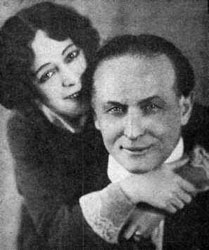
It was whilst working at Coney Island that Houdini met the woman who was to be his wife. 18-year-old Bess worked in a singing and dancing troupe called The Floral Sisters and after a whirlwind 2 week romance found herself Mrs. Houdini.
Bess took over the role of Theo in the double act and the Houdini’s worked their way around fairs, Indian reservations and at the famous P.T. Barnum’s museum.
Travelling around the Northeast and Midwest was good but times were very tough for the young couple. Houdini was proving to be masterful at marketing himself however and in 1898 he had developed his Handcuff Act. He promised to pay $100 to any audience member who could produce a pair of handcuffs that he couldn’t escape from. The trick earned him a reputation as an escapist but it did not pull in the money as Houdini had hoped.
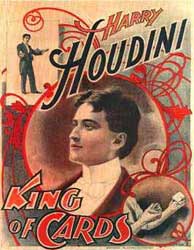
He supplemented his performances with card tricks and called himself the King of Cards. It was at one of his magic trick performances that he was noticed by a vaudeville booking agent, Martin Beck. Beck suggested that Houdini focused on his illusions and escapes and forget the magic tricks.
Houdini agreed and signed up under Beck performed at the Orpheum Circuit as the headline act. Starting at a salary of $60 per week Houdini soon became well known and his salary rose.
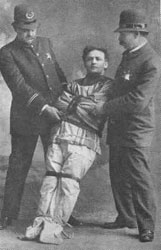
In cities around the States Houdini would ask policemen to lock him up in their jails. He would then escape and the publicity he received from such exploits meant that many more people wanted to come and see him perform. He was soon on $125 a week.
In 1900 Houdini was booked to perform in Europe. He soon became the highest paid entertainer in Europe with amazing feats such as escaping from a pair of handcuffs in Scotland Yard in London and wriggling out of 50 feet of rope. Making over $2,000 a week, Houdini enjoyed his time in Europe and sailed back to America with his wife in 1905 a (relatively) rich and happy man.
Houdini and Bess bought a home in New York City and continued to perform as vaudeville artists earning $1,200 a week. Houdini developed his illusions and escape tricks and his fame grew.
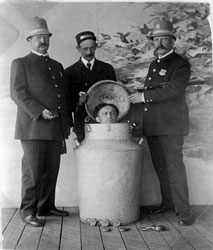
Tricks like escaping from coffins, plate glass boxes; plunging off a bridge into the San Francisco Bay with a 75 pound ball attached to his ankles whilst handcuffed; escaping from a giant water filled barrel and walking through a brick wall sealed his fame around the world.
Houdini travelled the globe and in 1910 bought an airplane for $5,000 and was the first person to fly in Australia.
He continued to make money and performed at a New York theatre where he received $8,000 for 8 weeks for his nightly escape from his Chinese Water Torture Cell.
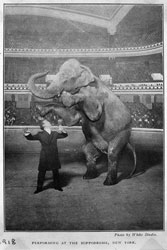
In 1918 Houdini introduced the world’s largest illusion at the Hippodrome in New York City. He made Jenny the elephant disappear in front of hundreds of astonished guests!
Houdini’s next foray was into movies and he made a series of thrillers. He also produced two films with himself as the star.
In 1925 he started his full evening magic and illusion show, which became a huge hit. He started to perform his Needle Trick where he swallowed dozens of threads and needles and then brought them back up again. All the needles were threaded!
Houdini became well known for his crusades against fake mediums and charlatans. Interested in the spiritual world, Houdini began his crusade following the death of his mother. Bereaved, he noticed that many ‘spiritualists’ attempted to use bereavement and grief as a way to make money and in Houdini’s mind that was unforgivable.
He continued to perform and escape death but it was on October 22nd 1926 at the Princess Theatre in Montreal an event happened that marked the beginning of the end for Harry Houdini.
He was surrounded by students from the McGill University and was asked if he could truly withstand a punch to the stomach thrown by any man. Houdini had long performed this trick and said it was true but before he could prepare himself by tightening his stomach muscles he was punched three times by J Gordon Whitehead. Hurt but unaware of the damage caused, Houdini continued with his performances and moved on to Detroit.
Unbeknownst to him, Houdini had actually suffered a burst appendix as a result of the surprise punches and became very ill. He was taken to Old Grace Hospital in Detroit and it was at Halloween, October 21st 1926 that Harry Houdini died of peritonitis aged just 52 years.
Before Houdini’s death, he had arranged a secret code with his wife Bess to see if he could make contact with her from the after life. Distraught with grief, Bess continued her Halloween séances for ten years after her husband’s death in an attempt to contact him but she never did.
People still try to contact Houdini through séances but nobody has ever heard from him. His name however is still as famous as it was when he was alive and few performers have matched Houdini’s flair for showmanship and publicity.
Join us soon for another Life Issues.