

Life Issues: And Judas Had a Brother

Lysias has a reputation for treachery, thievery, plague and just about every other trait undesirable in Roman times. Hated and despised throughout the city, Lysias is believed to be the brother of Judas Iscariot, the man who betrayed Jesus for thirty pieces of silver.
Lysius responds to his conscience
As the episode progresses, it is revealed that Lysias is, in fact, Judas and that he has lived with the guilt of Jesus’ death for twenty years. He is bitter and cynical, believing that he is damned and will never be forgiven for his treachery. As Jess alludes to, the forgiveness that Judas/Lysias actually seeks is from his own conscience. He has lost his self-respect because of his past actions.
Despite Lysias’ mistakes of the past and his shady reputation, we see him performing acts of great generosity, selflessness and kindness on at least two occasions. I don’t want to risk sound like a member of the Lysias fan club here but I think he does deserve at least a pat on the back for trying, despite his past mistakes.
The first such act is when he bursts in on the Romans and saves the children at the orphanage by feigning the plague. And what thanks does he get? None at all – they are too busy asking themselves – What is that scoundrel Lysias trying to get out of this situation?
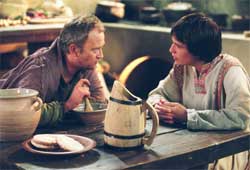
On the second occasion, Lysias helps the children escape from the city. Lysias’ actions are heroic in the face of what can only be described as ridicule from Sarah, Matthias and the population of the city.
The kindness he shows towards the children must go some way in easing his troubled conscience. It is symbolic and fitting that the 30 pieces of silver which he received as a result of betraying Jesus is actually used in a selfless way that his ex- teacher would have seen fit.
Righting a wrong
Through Lysias’ actions we learn that although somebody has made grave mistakes in the past, they are always capable of making up for those mistakes with generosity and kindness.
If we have done something that we feel bad about, most of us get a pang of conscience. This is especially true if we have never acted to rectify or put right the situation. The guilt in such situations can be excruciating. The best way to fix this is, of course, to do something for the person that you think has come off second best.
You’ve heard the saying, “Two wrongs don’t make a right,” but it’s perhaps more true that a ‘right’ can certainly go along way in making up for a ‘wrong.’
You’ll certainly end up feeling a lot better about the situation and so, hopefully, will the previously ‘injured’ party.

Giving people a second chance
On the other side of the coin, it is important that we do not always judge a person on a past reputation. If somebody has done something wrong, like Lysias, they are still capable of acting in a way which is uncharacteristic with their past actions.
Sometimes we have to put the past behind us and concentrate on the present. It is often necessary to forgive. Jess recognises this when he says about Lysias ” Not everything they say about him is true.” I think that Jess realises early on that Lysias is not everything that he seems and that some good may come from his past mistakes.
It is no good bearing grudges as this makes people feel more bitter. We all probably know of families where people do not talk to each other because of something that has been said long ago. Often time makes these wounds deeper and making up a lot harder to do.
The best thing to do is to wipe the slate clean and give the person a second chance. It is likely that they will be eager to show you how wrong they were the first time.