

Life as a servant in Victorian England
Different servants had different levels of responsibility and different levels of privileges.
The cook, is one of the most important members of the domestic staff of a Victorian household. She would typically have her own bedroom, and earn a salary about double that of a housemaid or chambermaid. Her realm is the kitchen and dining room. She would be involved in menu planning with the lady of the house, and from that would be responsible for shopping, running the kitchen, preparing the meal, cleaning the china and polishing the silverware. She would cook for the family and for the service staff.
The housemaid, would assist the lady of the house with her changes of clothes (typically three changes a day). She would clean the front door and steps, then work in the parlour removing the soot left by the coal fires, candles and oil lamps. Next she would make the beds, sweep the carpets, dust the furniture and ornaments. Depending on the number of other staff, she may also have to do the laundry. It would be a long hard day. She would have started in the job young – about 18, and would share sleeping quarters in the attic with other female members of the domestic staff. She would receive a small salary and be provided with room and board.
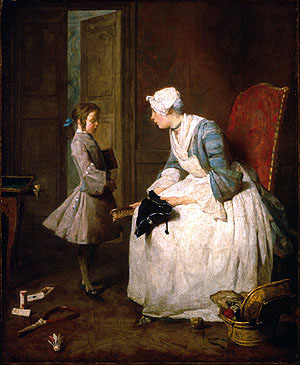
The uncertain social status of governesses made the role a difficult one. She was typically a single, middle-class woman who had to earn her own living. Although being a governess might be a degradation, employing one was a sign of culture and means. The psychological situation of the governess made her position unenviable. Her presence created practical difficulties within the Victorian home because she was neither a servant nor a member of the family. She was from the same social level as the family, but the fact that she was paid a salary put her at the economic level of the servants.
Time off for the staff is at the discretion of the employer, typically one day a month, plus one week a year would be acceptable, as well as a couple of hours off on Sunday to attend church.
One of the most remarkable characteristics of early Victorian domestic workers is the uncomplaining acceptance of conditions of life and work. There is a sense resignation to the facts of life, the feeling that human existence is a struggle and that survival is an end in itself.
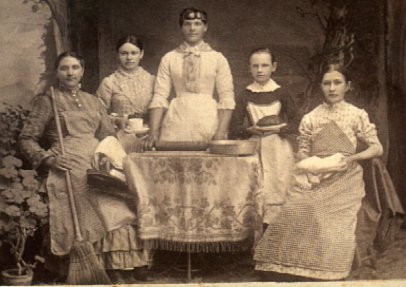
This resignation resulted from a long history of deprivation and suffering by which generations of working people had been accustomed to poverty, personal tragedy and limited expectations. These attitudes are true of the great majority, though not of all. Their intellectual and cultural horizons are strictly limited: very few concern themselves with national events or politics, they are uninterested in material acquisition or achievement; they are not socially mobile and barely conscious of class beyond a recognition that the ‘masters’ constitute a different order of society into which they will never penetrate. Their aspirations are modest to be respected by their fellows, to see their families growing up and making their way in the world, to die without debt and without sin. Any happiness which life has to offer was to be found in social contacts within the family, the work-group, or the church.
Toward the end of the Victorian age, there became a shortage of domestic workers as young women preferred the more social atmosphere and shorter working hours in factory work to the longer hours worked in domestic service. A housemaid’s day would typically extend from 6 A.M. until 10 P.M., during which she had two-and-a-half hours for meals and an hour-and-a-half in the afternoon for needlework, a total of four hours “rest.” This meant twelve hours of actual work, longer by two hours than a factory woman’s day.
On Saturday, when the factory hand worked two hours less than usual, the servant worked longer, and on Sunday, when the factory worker could rest completely, the servant was still required to work almost a normal day. Eighty hours of actual work a week, against fifty-six for the factory worker, may well be a fair estimate for the late nineteenth century, and must have been exceeded in many single-handed households. It is no wonder many women moved into factory work in this period.
Join us soon for another Life Issues.