

Life Issues – Wales – Welsh Coal
Wales is a small mountainous country situated on the west side of the English Island. It is surrounded by water on three sides, and is mainly mountainous. There are few natural resources in Wales, but one resource that they have identified has proved extremely valuable for over two thousand years: Coal.
Coal mining has been the primary industry in Wales throughout recorded history in Wales, and dates as far back as the Bronze Age at least. Mining as become a part of the identity of most Welshmen.
By isolating a seemingly limitless local source of fuel, Wales was once able to maintain its energy needs at a local level, thus taking fuel out of the Welsh field of international politics. This meant that, without having to coddle to foreign interests for fear of losing oil trade, Wales was able to function more freely and independently than most nations.
However the industry has come under a large amount of scrutiny in recent years, causing a major collapse of the industry. This has bankrupted many mining communities, forcing coal miners to leave Wales in search of more steady industry in England.
Workin’ in a Coal Mine, Hi-Ho, etc.
Miners are forced to do extremely difficult work in notoriously hazardous working conditions.
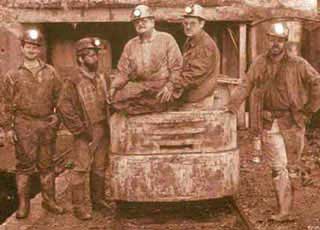
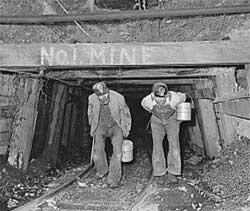
Miners traditionally work in pairs of two, allowing them to keep each other company as they work, lend an extra hand on tasks impossible to accomplish individually, and, most importantly, to send one man off for help in case any trouble strikes.
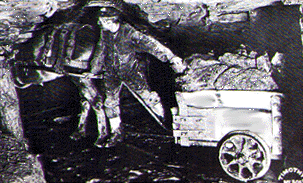
In order to extract coal from the earth, miners dig a maze of tunnels into the ground, with numerous shafts and chambers. Until recent years, coal had to be extracted using the brute strength of human muscles. Miners used a diverse palate of hammers and picks to ‘undermine’ a chamber, basically carving out a hollow crevice underneath the coal to be extracted. Through a series of seemingly ridiculous bodily contortions, a pair of minors could work all day to undermine an area the size of a small bedroom.
After undermining, a small hole is drilled or carved out and filled with explosive powder. This hole, though seemingly a small accent to the large task of undermining, requires extreme skill, as it will determine the nature of the explosion. The coal is then literally blasted out of the rock for extraction.
Fear and Safety
Maintaining a coal mine requires intense focus on the physical qualities of the mine itself. The most difficult problems of a coal mine are the natural elements: Earth, Wind, Fire, Water.
It is easy to forget about water’s place in the mines. Water was used in the mining process, in a technique that takes advantage of matter’s tendency to expand under heat. Miners wishing to excavate a new area would light a fire against a rock wall, causing the rock to expand under the heat. They would then expel the fire using water, causing the wall to cool so rapidly that the wall would crack just as a drinking glass may do if you throw ice into hot tea.
Additionally, water naturally seeps into the earth. It could also drain into a mine through its openings, or suddenly well up from a new chamber if a miner taps into an underground spring. Without a draining mechanism, the mines could easily fill with water, drowning the workers in an enclosed flood.
In the thousands of years that mines existed before electricity was tamed, a simple mechanical process was needed to remove water. The solution? Steam. The water was heated with fire until it changed into a gaseous phase and naturally rose out of the mine, the way steam will rise from a pot of boiling water.
Even with the water issue sorted, miners were in danger of drowning in air, or suffocating. In tunnels that often went thousands of feet into the earth, air was stale. There was no wind to move clean air in, and most of the oxygen was drained from the air over the course of a day.
Workers were constantly breathing in coal dust, which would settle around their lungs in an abrasive film. Additionally, coal was often accompanied with poisonous gasses such as methane, so that, in harvesting their product, miners were constantly in danger of subjecting themselves to deadly gas, which often carried no odour.
The practise of bringing a bird or small animal into the mine could give miners an early indication of danger—at the expense of the unfortunate animal! Miners also used a process much like the steam evacuation of water to increase air circulation. Shafts were built into mines specifically for circulation. They were basically deep chimneys with a furnace burning at the very bottom. If you have ever watched the wavering of air over a campfire, you can understand that the heat increases air movement. So the fire worked to get air moving within the mine, much like a fan, except that it would heat the mines, rather than cooling them.
The fire could be a liability in itself. Like people, fire expends oxygen. So, while it was helping to move air around, thus shifting fresher air into the stale passageways, the fire was also adding to the problem of reduced oxygen. And then there’s this small detail: fire burns. And often the burning spreads. The mines were filled with timber—wooden beams were used as mechanical tools, and for structural support in the mines, even lining the shaft in which the furnace burned! The fire used to solve the air and water problems could suddenly turn on the miners, proving equally deadly.
And finally, there was the danger of the mine itself. Mining may be unique in that is a profession in which the workers reshape their work environment. If the miners unknowningly struck the rock wall in a weak spot they could damage the structural stability of the mine, causing rock slides and cave-ins.
These dangers were very real. Literally hundreds of thousands of miners have died in Welsh mining disasters. Statistics around 1900 showed that a Welsh miner died every two minutes, and a miner died every six hours!
Women and Children First!
Mining was not a field for men only. Children as young as five years old were commonly recruited into the field. Miners who had worked since childhood proved to have better skills as adults than men that joined the field at adulthood. There were many tasks (for instance operating the hand-cranked cart to lift men in and out of the mine) that male miners refused to do. So, while the actual mining was left to the men and boys,, women and girls often worked gruelling 12-hour days inside the mines as well, subjecting themselves to many of the dangers the male workers encountered, injuries and common respiratory illnesses.
It wasn’t until the industrial revolution that labour laws were created, addressing the working conditions for the child labour.
The Collapse of Mining
The early 20th century saw numerous coal miners’ strikes (including that that almost kept the ship Titanic out of the water), and the coal industry was shuffled between the government and private ownership. It became very difficult for mine owners to give their workers the conditions they demanded, without cutting into their profits.
By 1950, it had become cheaper to acquire oil and even coal from overseas importers. Most of the Welsh mines were shut down while there was still coal left to be mined. Mines have been filled in, built over. Nowhere in the world has the collapse of the mining industry been so dramatic as in South Wales. The loss of the coal industry has had devastating effect on the economy, from which Wales is still recovering
Join us soon for another Life Issues.